

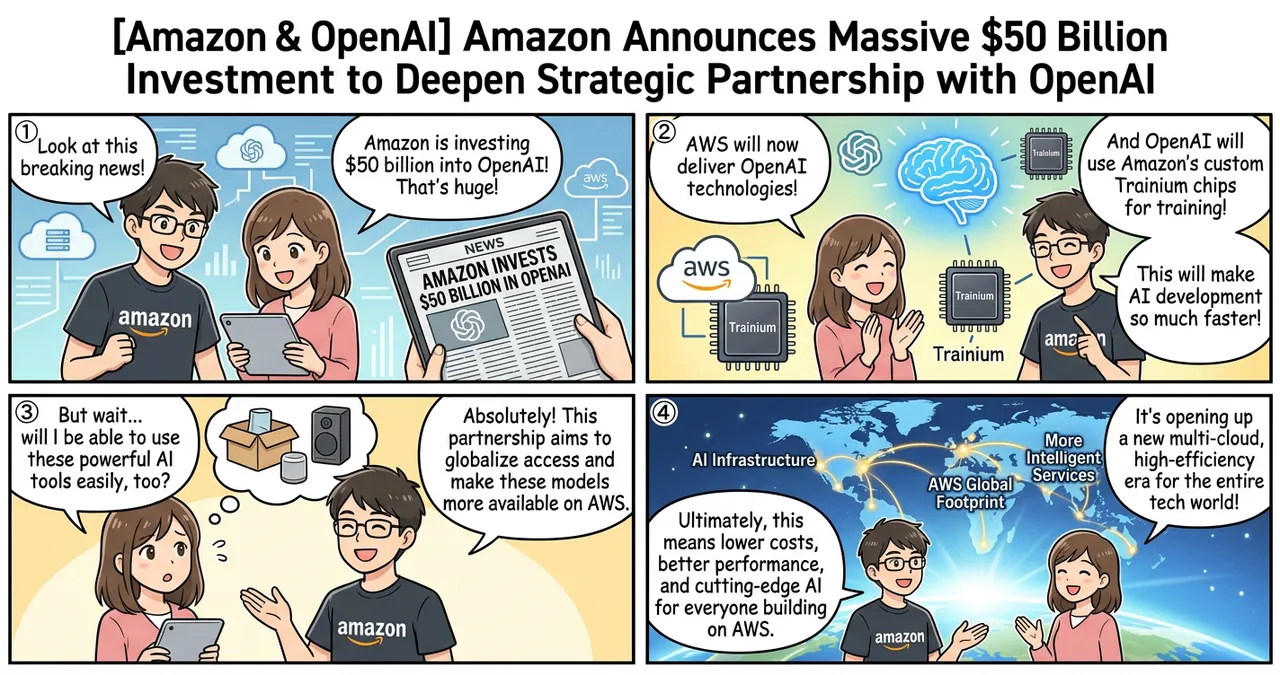
Amazon has announced a monumental strategic investment in OpenAI totaling $50 billion, marking one of the largest financial commitments in the history of the technology industry. This partnership signifies a major shift in the competitive landscape of artificial intelligence infrastructure. By positioning Amazon Web Services (AWS) as a primary delivery vehicle for OpenAI’s technologies, the two companies aim to accelerate the deployment of advanced AI models at a global scale.
Key Takeaways
- Amazon will invest a total of $50 billion in OpenAI, beginning with an initial tranche of $15 billion to fuel immediate growth.
- AWS becomes the exclusive third-party cloud delivery provider for OpenAI, broadening the reach of OpenAI’s models beyond existing primary partnerships.
- The deal centers on the integration of Amazon’s custom-designed Trainium chips, which will be utilized to train and run next-generation AI models.
Detailed Breakdown
A Phased Financial Commitment
The $50 billion investment is structured to support OpenAI’s long-term capital requirements for research and infrastructure. The initial $15 billion provides the immediate liquidity necessary for scaling compute resources. This announcement follows recent reports that [OpenAI] OpenAI Raises $110B as Valuation Soars to $730B, highlighting the massive scale of capital now flowing into the generative AI sector to maintain its rapid trajectory.
AWS as the Strategic Delivery Hub
Under the terms of the agreement, AWS will serve as the exclusive third-party cloud provider for OpenAI. While OpenAI has historically maintained a deep-rooted relationship with Microsoft Azure, this new arrangement allows OpenAI to leverage the massive global footprint and enterprise-grade security of AWS. This move effectively diversifies OpenAI’s infrastructure and provides AWS customers with more direct access to cutting-edge models.
Hardware Synergy with Trainium
A critical component of this partnership is the adoption of Amazon’s proprietary AI hardware. OpenAI will utilize Amazon’s “Trainium” chips for large-scale model training. This represents a significant move away from total reliance on traditional GPU architectures. By optimizing software to run on Trainium, OpenAI expects to achieve higher performance-per-watt and lower operational costs for its massive neural networks.
Why Is This Significant?
The technical significance of this deal lies in the diversification of both cloud infrastructure and hardware. Until now, OpenAI’s growth was inextricably linked to a single cloud ecosystem. By introducing AWS and Trainium into the mix, OpenAI gains unprecedented flexibility.
| Feature | Previous Approach | New Strategic Partnership |
|---|---|---|
| Cloud Provider | Primarily Microsoft Azure | Multi-cloud (Azure + AWS exclusive 3rd party) |
| Primary Hardware | NVIDIA GPUs | NVIDIA GPUs + Amazon Trainium Chips |
| Investment Scale | Incremental Billions | $50 Billion Total Commitment |
| Market Reach | Azure Ecosystem | Global AWS Enterprise Reach |
The use of Trainium is particularly noteworthy for engineers. These chips are designed specifically for the high-throughput requirements of deep learning. Integrating them into OpenAI’s workflow suggests a high level of confidence in Amazon’s silicon capabilities, potentially offering a blueprint for other AI labs to reduce hardware dependency.
Impact on the Tech Industry
For engineers and tech companies, this partnership signals a shift toward a more multi-polar AI infrastructure environment. AWS developers will likely see deeper, more native integrations of OpenAI’s latest models within the AWS ecosystem, such as Amazon Bedrock.
Furthermore, the emphasis on Trainium chips provides a massive boost to the custom silicon market. It encourages a shift in the industry where specialized AI accelerators become viable alternatives to general-purpose GPUs. Companies building on AWS can expect more competitive pricing and better availability as Amazon scales its internal chip production to meet OpenAI’s demands.
Points to Consider
While the investment is historic, several factors warrant objective observation. Regulatory bodies in multiple jurisdictions are increasingly scrutinizing large-scale partnerships between big tech firms and AI startups. The complexity of managing a multi-cloud strategy could also introduce operational overhead for OpenAI as they balance workloads between Azure and AWS. Additionally, the success of the hardware aspect depends on the seamless porting of OpenAI’s proprietary training stacks to the Trainium architecture, which requires significant engineering effort.
Try It Yourself
Readers interested in exploring the technologies mentioned in this article can take the following steps:
- Explore AWS Bedrock: Access various high-performance foundation models to understand how Amazon integrates third-party AI into its cloud environment.
- Review Trainium Documentation: Visit the AWS website to read the technical specifications and benchmarks of the Trainium and Inferentia chip families.
- Monitor OpenAI API Updates: Keep an eye on OpenAI’s developer portal for any announcements regarding new endpoints or features hosted on AWS infrastructure.
Summary
Amazon’s $50 billion investment in OpenAI represents a fundamental realignment of the AI industry’s power structure. By combining AWS’s global infrastructure and custom Trainium silicon with OpenAI’s leading models, the partnership aims to lower the barriers to AI scaling. This collaboration likely sets the stage for a new era of high-efficiency, multi-cloud AI development.
Why It Matters
This news is a defining moment for the AI industry because it breaks the hardware and cloud monopolies that threatened to bottleneck innovation. It ensures that the most advanced AI models have access to the diversified infrastructure and massive capital required to reach the next stage of intelligence.
Primary Sources
Glossary
- Trainium: A custom-designed AI chip developed by Amazon specifically for training deep learning models with high efficiency.
- Third-Party Cloud Delivery Provider: A company that provides cloud computing services (like storage or processing) to another company to help them distribute their products to end-users.
- Strategic Partnership: A formal agreement between two or more enterprises to pursue a set of agreed-upon goals while remaining independent organizations.
![[OpenAI] OpenAI Raises $110B as Valuation Soars to $730B](https://4koma-news.com/images/posts/en/72-2026-02-28-openai-funding-valuation-blog.webp)
![[Weekly AI Industry & Trends] Top 5 News to Watch (3/1 - 3/8)](https://4koma-news.com/images/posts/en/89-weekly-ai-news-other-2026-03-08-blog.webp)
![[Weekly AI Model Updates] Top 5 News to Watch (3/15 - 3/22)](https://4koma-news.com/images/posts/en/90-weekly-ai-news-model-2026-03-22-blog.webp)
![[Weekly AI Model Updates] Top 5 News to Watch (3/8 - 3/15)](https://4koma-news.com/images/posts/en/90-weekly-ai-news-model-2026-03-15-blog.webp)

