

Key Takeaways
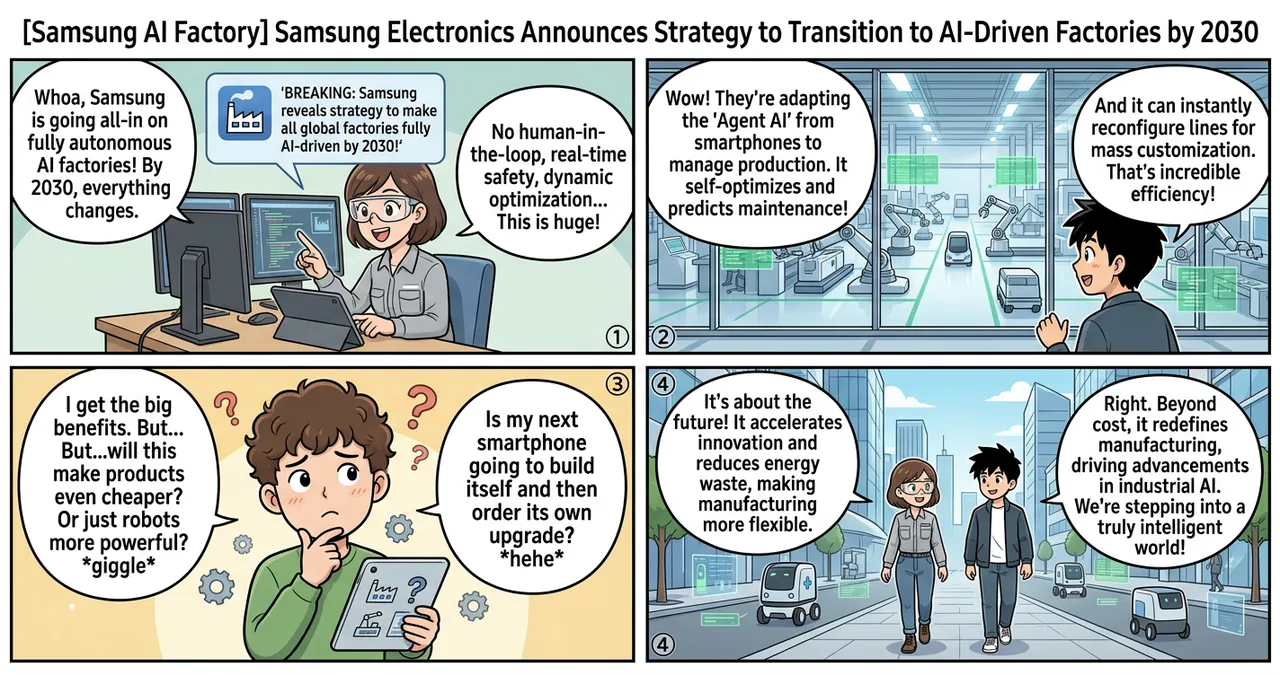
- Global manufacturing transition by 2030 aims to convert all Samsung production hubs into fully autonomous, AI-driven environments.
- Integration of “Agent AI” technology, originally developed for the Galaxy S26, will allow production lines to self-optimize and manage complex workflows.
- Real-time safety and efficiency management will be achieved through a combination of vision AI and edge computing, reducing human intervention in hazardous tasks.
Detailed Breakdown
Integration of Agentic AI in Production
The core of Samsung’s strategy involves repurposing the “Agent AI” architecture found in its latest consumer electronics for industrial applications. Unlike traditional automation, which follows rigid pre-programmed scripts, Agent AI can perceive changes in the manufacturing environment and make independent decisions. For example, if a specific component is slightly misaligned, the AI agent can recalibrate the robotic arm in real-time without pausing the entire assembly line.
Autonomous Optimization and Predictive Maintenance
Samsung plans to utilize massive datasets generated by its global supply chain to feed its proprietary AI models. These models will predict equipment failures before they occur, scheduling maintenance during natural downtime to ensure 24/7 operation. The system also monitors energy consumption across facilities, adjusting power usage based on production demand and local utility rates to minimize the carbon footprint.
Enhanced Safety via Vision AI
Safety management will undergo a significant upgrade through the deployment of advanced vision AI systems. These systems monitor the factory floor for anomalies, such as unauthorized personnel in restricted zones or equipment overheating. By processing data at the edge—meaning directly on-site rather than in a distant cloud—the system can trigger emergency shutdowns or alerts within milliseconds, significantly reducing the risk of workplace accidents.
Why Is This Significant?
The transition from a “Smart Factory” to an “AI-Driven Factory” represents a paradigm shift in industrial engineering. Previous approaches relied on human operators to interpret data and make final decisions. Samsung’s new model moves toward a closed-loop system where the AI acts as both the analyst and the executor.
| Feature | Traditional Smart Factory | Samsung AI-Driven Factory (2030) |
|---|---|---|
| Decision Making | Human-in-the-loop | Autonomous (Agent AI) |
| Data Processing | Centralized Cloud | Edge Computing & On-site AI |
| Maintenance | Scheduled/Reactive | Predictive/Proactive |
| Flexibility | High reconfiguration cost | Dynamic self-optimization |
This approach allows for “Mass Customization,” where a single production line can switch between different product specifications instantly, a feat that previously required hours of manual retooling.
Impact on the Tech Industry
Samsung’s announcement sets a high benchmark for the global manufacturing sector. Competitors in the semiconductor and consumer electronics industries will likely feel pressured to accelerate their own autonomous roadmaps to remain cost-competitive. For engineers, this shift signals a growing demand for “Industrial AI” specialists who can bridge the gap between software development and mechanical engineering. Furthermore, the large-scale adoption of Agent AI in factories will likely drive innovations in robotics and sensor technology, as hardware must keep pace with increasingly sophisticated software.
Points to Consider
While the strategy is ambitious, several challenges remain. Upgrading legacy manufacturing plants to support high-speed AI processing requires significant capital expenditure and infrastructure overhauls. Cybersecurity also becomes a paramount concern; as factories become more autonomous and interconnected, they potentially become larger targets for sophisticated cyber-attacks. Additionally, the transition necessitates a massive upskilling of the current workforce, as the role of factory workers shifts from manual labor to overseeing and maintaining complex AI systems.
Try It Yourself
- Research Agentic AI: Explore the conceptual framework of “Agentic AI” to understand how autonomous decision-making differs from standard machine learning.
- Monitor Samsung Newsroom: Keep an eye on official technical whitepapers regarding the Galaxy S26’s AI architecture, as this serves as the foundation for the industrial version.
- Evaluate Automation Tools: If you work in a technical field, investigate edge computing platforms like NVIDIA Jetson or AWS IoT Greengrass to see how local AI processing is implemented today.
Summary
Samsung Electronics is embarking on a transformative journey to replace traditional manufacturing models with a global network of autonomous, AI-driven factories by 2030. By leveraging the same Agent AI technology found in its flagship smartphones, the company aims to achieve unprecedented levels of efficiency, safety, and production flexibility. This move not only solidifies Samsung’s position as a technology leader but also signals a new era for the global industrial landscape where machine intelligence takes center stage.
Why It Matters
This strategy marks the first global-scale application of “Agentic AI” in heavy industry, moving beyond simple automation to true machine autonomy. It demonstrates how consumer-grade AI breakthroughs can be scaled to solve complex industrial challenges, potentially reshaping the global economy and the future of work.
Primary Sources
Glossary
- Agent AI: A type of artificial intelligence capable of autonomous reasoning and taking actions to achieve specific goals within an environment.
- Edge Computing: A distributed computing paradigm that brings computation and data storage closer to the sources of data, such as factory sensors, to improve response times.
- Predictive Maintenance: A technique that uses data analysis tools to detect anomalies in operation and potential defects in equipment so they can be fixed before failure.
![[Weekly AI Industry & Trends] Top 5 News to Watch (3/1 - 3/8)](https://4koma-news.com/images/posts/en/89-weekly-ai-news-other-2026-03-08-blog.webp)
![[Weekly AI Industry & Trends] Top 5 News to Watch (3/15 - 3/22)](https://4koma-news.com/images/posts/en/91-weekly-ai-news-other-2026-03-22-blog.webp)
![[Weekly AI Model Updates] Top 5 News to Watch (3/15 - 3/22)](https://4koma-news.com/images/posts/en/90-weekly-ai-news-model-2026-03-22-blog.webp)
![[Weekly AI Industry & Trends] Top 5 News to Watch (3/8 - 3/15)](https://4koma-news.com/images/posts/en/91-weekly-ai-news-other-2026-03-15-blog.webp)

