

Key Takeaways
- Vietnam has become the first country in Southeast Asia to implement a comprehensive legal framework specifically governing artificial intelligence.
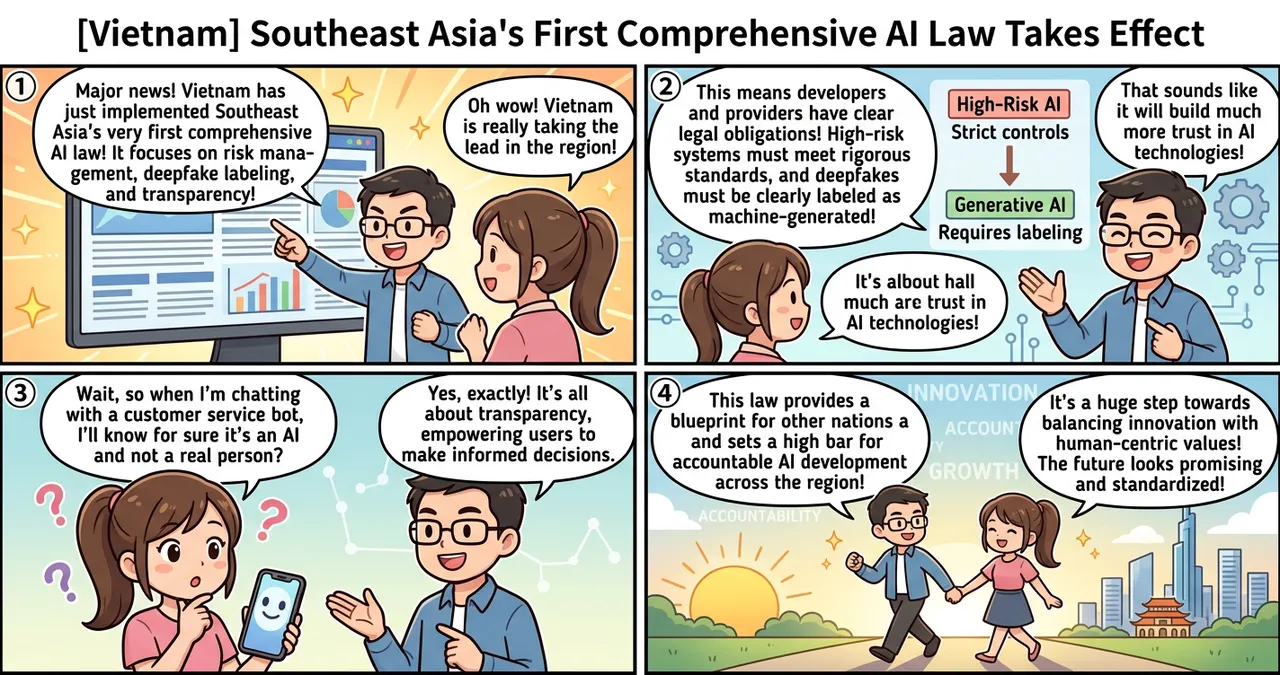
- The law mandates strict transparency requirements, including the mandatory labeling of deepfakes and clear disclosure when users interact with AI agents.
- The framework adopts a risk-based approach similar to the European Union’s AI Act, categorizing systems based on their potential impact on safety and fundamental rights.
Detailed Breakdown
A Shift from Guidelines to Binding Law
On March 1, 2026, Vietnam officially enacted its comprehensive AI Law, marking a significant departure from the voluntary ethical guidelines previously seen across the ASEAN region. This legislation establishes a formal regulatory body and sets clear legal obligations for developers, providers, and deployers of AI systems. The law aims to foster innovation while ensuring that digital transformation does not compromise national security or social order.
Risk-Based Categorization
Central to the law is a classification system that categorizes AI applications into different risk levels. High-risk systems—such as those used in critical infrastructure, healthcare, or law enforcement—must undergo rigorous conformity assessments and maintain detailed technical documentation. Applications deemed to pose “unacceptable risk” to human rights or safety are prohibited entirely.
Transparency and Generative AI
The regulation places heavy emphasis on mitigating the risks associated with generative AI. Any content generated or manipulated by AI that resembles real persons, places, or events (deepfakes) must be clearly labeled. Furthermore, businesses deploying AI agents for customer service or automated tasks are legally required to inform users that they are interacting with a machine, not a human.
Why Is This Significant?
The enactment of this law represents a major milestone in global AI governance. By moving first in Southeast Asia, Vietnam provides a blueprint for neighboring nations currently debating their own regulatory paths.
| Feature | Previous ASEAN Guidelines | Vietnam’s New AI Law |
|---|---|---|
| Legal Status | Voluntary / Non-binding | Legally Binding / Mandatory |
| Enforcement | None | Fines and operational bans |
| Deepfake Rules | Ethical suggestions | Mandatory digital watermarking/labeling |
| AI Agents | No specific requirements | Mandatory disclosure to users |
This shift ensures that AI development in the region moves toward a standardized model of accountability. It also aligns Vietnam with international standards, potentially making it a more attractive destination for global firms seeking a stable and predictable regulatory environment.
Impact on the Tech Industry
For engineers and tech companies, this law introduces a new layer of compliance. Development cycles must now incorporate “compliance by design,” ensuring that data lineage is traceable and that risk assessments are conducted before deployment.
Global tech giants operating in Vietnam will need to localize their safety protocols to meet these specific requirements. While this may increase operational costs in the short term, it provides a clear legal shield for companies that follow the rules, reducing the risk of arbitrary government intervention or public backlash over AI-related incidents.
Points to Consider
While the law provides a clear framework, several challenges remain. The technical implementation of “unambiguous labeling” for deepfakes is still a subject of global debate, and it remains to be seen how Vietnam will enforce these rules on platforms hosted outside its borders.
Additionally, there is the ongoing challenge of balancing strict regulation with the need for economic growth. Small-scale startups may find the burden of high-risk assessments difficult to navigate without government support or simplified compliance pathways for smaller enterprises.
Try It Yourself
If you are involved in AI development or deployment, consider these immediate steps to align with the new standards:
- Conduct an AI Audit: Catalog all AI systems currently in use and classify them according to potential risk levels.
- Implement Labeling Protocols: Integrate digital watermarking or metadata tags into generative AI outputs to ensure content is identifiable as machine-generated.
- Update User Interfaces: Ensure that any chatbot or automated agent clearly identifies itself as an AI at the start of every interaction.
- Review Data Governance: Verify that the data used for training AI models complies with the new standards for quality and intellectual property rights.
Summary
Vietnam’s new AI law establishes a comprehensive regulatory foundation that prioritizes transparency and risk management. By requiring deepfake labeling and AI agent disclosure, the country is taking proactive steps to combat misinformation and automated deception. This move not only sets a high bar for Southeast Asia but also signals a broader global trend toward harmonizing AI regulations with human-centric values.
Why It Matters
This news marks the transition of Southeast Asia from “soft law” to “hard law” in the AI sector. It forces developers to move beyond ethical theory and implement concrete technical safeguards, fundamentally changing how AI products are built and marketed in emerging digital economies.
Primary Sources
Glossary
- Deepfake: Synthetic media in which a person in an existing image or video is replaced with someone else’s likeness using artificial neural networks.
- AI Agent: An autonomous or semi-autonomous system designed to perform specific tasks or interact with users to achieve a goal.
- Risk-Based Approach: A regulatory strategy where the level of oversight and requirements is proportional to the potential harm a technology could cause.
- Conformity Assessment: A process used to demonstrate that a product, service, or system meets specified technical and legal requirements.
![[Weekly AI Industry & Trends] Top 5 News to Watch (2/22 - 3/1)](https://4koma-news.com/images/posts/en/81-weekly-ai-news-other-2026-03-01-blog.webp)
![[Weekly AI Industry & Trends] Top 5 News to Watch (3/1 - 3/8)](https://4koma-news.com/images/posts/en/89-weekly-ai-news-other-2026-03-08-blog.webp)
![[Weekly AI Model Updates] Top 5 News to Watch (2/22 - 3/1)](https://4koma-news.com/images/posts/en/80-weekly-ai-news-model-2026-03-01-blog.webp)
![[Anthropic Ban] US Administration Designates Anthropic as 'Supply Chain Risk,' Prohibits Federal Use](https://4koma-news.com/images/posts/en/74-2026-03-01-trump-anthropic-ban-blog.webp)

