

Key Takeaways
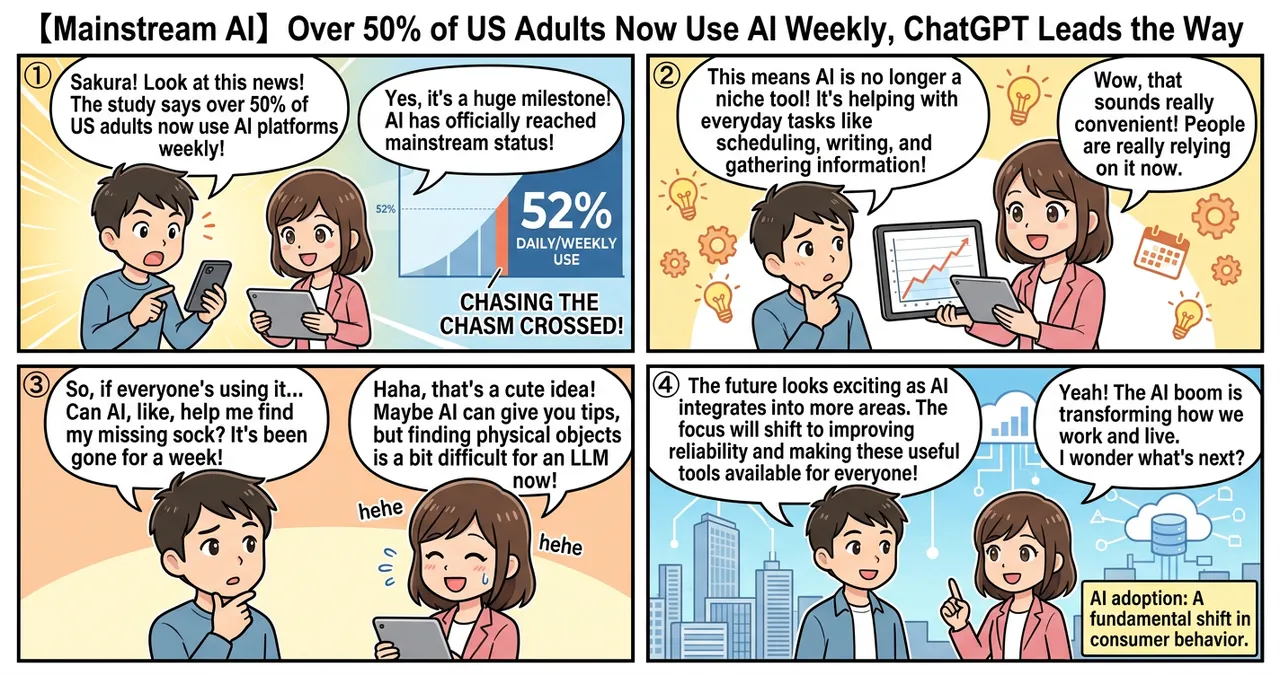
- Majority adoption has been achieved, with 52% of United States adults now reporting that they use AI platforms on a weekly basis.
- ChatGPT remains the dominant force in the consumer market, serving as the primary entry point and most frequently used tool for the general public.
- AI has officially “crossed the chasm," moving from a niche tool for early adopters to a mainstream technology utilized by the early majority.
Detailed Breakdown
The Scope of the AI User Metrics Study
The latest “AI User Metrics” study, conducted by Edison Research in partnership with SSRS, provides a comprehensive look at how artificial intelligence has permeated daily life in the United States. Unlike previous surveys that focused on “ever used” statistics, this research highlights frequent, habitual usage. The data indicates that AI is no longer a novelty but a recurring utility for over half of the adult population.
Frequency and Consistency of Use
The 52% figure represents a significant milestone in technology adoption. This level of weekly engagement suggests that AI chat interfaces are being integrated into routine workflows, educational activities, and personal information gathering. The survey underscores a shift from experimental “testing” of the technology to a state of reliance for specific weekly tasks.
Market Share and Platform Preference
Among the various platforms available, ChatGPT continues to hold the largest share of the market. Its brand recognition and first-mover advantage have allowed it to become synonymous with “AI chat” for many consumers. While other platforms like Claude, Gemini, and Perplexity are gaining traction, the study confirms that the majority of weekly users gravitate toward OpenAI’s ecosystem for their primary needs.
Why Is This Significant?
The significance of these findings lies in the speed of adoption compared to previous technological revolutions. AI has reached the “Early Majority” phase of the diffusion of innovations curve much faster than the internet or smartphones did in their respective eras.
| Metric | Early Adopter Phase | Mainstream (Current Phase) |
|---|---|---|
| User Base | Tech enthusiasts and developers | General public, students, office workers |
| Primary Use | Testing capabilities and coding | Information retrieval, drafting, and planning |
| Market Status | Experimental/Niche | Essential Utility |
| Frequency | Occasional/Sporadic | Weekly or Daily |
By crossing the “chasm,” AI has moved past the point where it might fail due to a lack of interest from the general public. The infrastructure of daily communication and information management is now fundamentally tied to these models.
Impact on the Tech Industry
For engineers and technology companies, this mainstream adoption signals a shift in development priorities. The focus is moving away from simply proving that a Large Language Model (LLM) works and toward optimizing user experience, reliability, and specific vertical integrations.
Companies worldwide must now assume that their user base is already familiar with AI interfaces. This necessitates the integration of AI features into standard software products to meet consumer expectations. Furthermore, the high usage rates put pressure on infrastructure providers to scale computing power and reduce latency, as “weekly use” by half the population translates to massive concurrent demand on GPU clusters and data centers.
Points to Consider
While the adoption rates are high, several challenges remain for the industry to address objectively:
- Accuracy and Trust: As more people rely on AI for weekly tasks, the impact of “hallucinations” or factual errors becomes more widespread, potentially affecting professional and academic outcomes.
- Privacy Concerns: With over 100 million adults inputting data into these systems weekly, the management of personal and proprietary information remains a critical point of scrutiny for regulators.
- The Digital Divide: While 52% use AI weekly, nearly half the population does not. This gap could lead to disparities in productivity and information access between those who leverage AI and those who remain outside the ecosystem.
Try It Yourself
To keep pace with the mainstream adoption of AI, consider taking the following steps:
- Audit Your Routine: Identify one repetitive task you perform weekly (such as meal planning, email drafting, or data summarization) and test an AI tool to assist with it.
- Explore Multi-Platform Use: While ChatGPT is the leader, try comparing its outputs with other models like Claude or Gemini to understand the strengths of different architectures.
- Verify Outputs: Establish a habit of cross-referencing AI-generated information with primary sources to ensure the accuracy of the tools you are using.
Summary
The findings from Edison Research and SSRS confirm that AI has reached a tipping point, with over half of US adults utilizing the technology on a weekly basis. This transition to mainstream status suggests that AI chat interfaces are becoming a permanent fixture of the digital landscape. As usage continues to grow, the focus will likely shift toward refining the accuracy and security of these tools to support an increasingly reliant user base.
Why It Matters
This data provides empirical evidence that the generative AI boom is not a temporary bubble but a fundamental shift in consumer behavior. For the AI industry, it validates the current trajectory of massive investment and indicates that the primary challenge is no longer user acquisition, but the sustainable delivery of high-quality, reliable AI services to a mass audience.
Primary Sources
Glossary
- The Chasm: A term from the Diffusion of Innovations theory representing the gap between early adopters (tech enthusiasts) and the early majority (the general public).
- Early Majority: The first large group of the general population to adopt a new piece of technology after it has been proven by early adopters.
- LLM (Large Language Model): A type of AI trained on vast amounts of text data to understand, generate, and manipulate human language.
![[Claude] Anthropic's App Surpasses ChatGPT in US App Store Rankings](https://4koma-news.com/images/posts/en/82-2026-03-01-claude-tops-app-store-blog.webp)
![[Weekly AI Industry & Trends] Top 5 News to Watch (3/15 - 3/22)](https://4koma-news.com/images/posts/en/91-weekly-ai-news-other-2026-03-22-blog.webp)
![[Weekly AI Model Updates] Top 5 News to Watch (3/15 - 3/22)](https://4koma-news.com/images/posts/en/90-weekly-ai-news-model-2026-03-22-blog.webp)

