

Key Takeaways
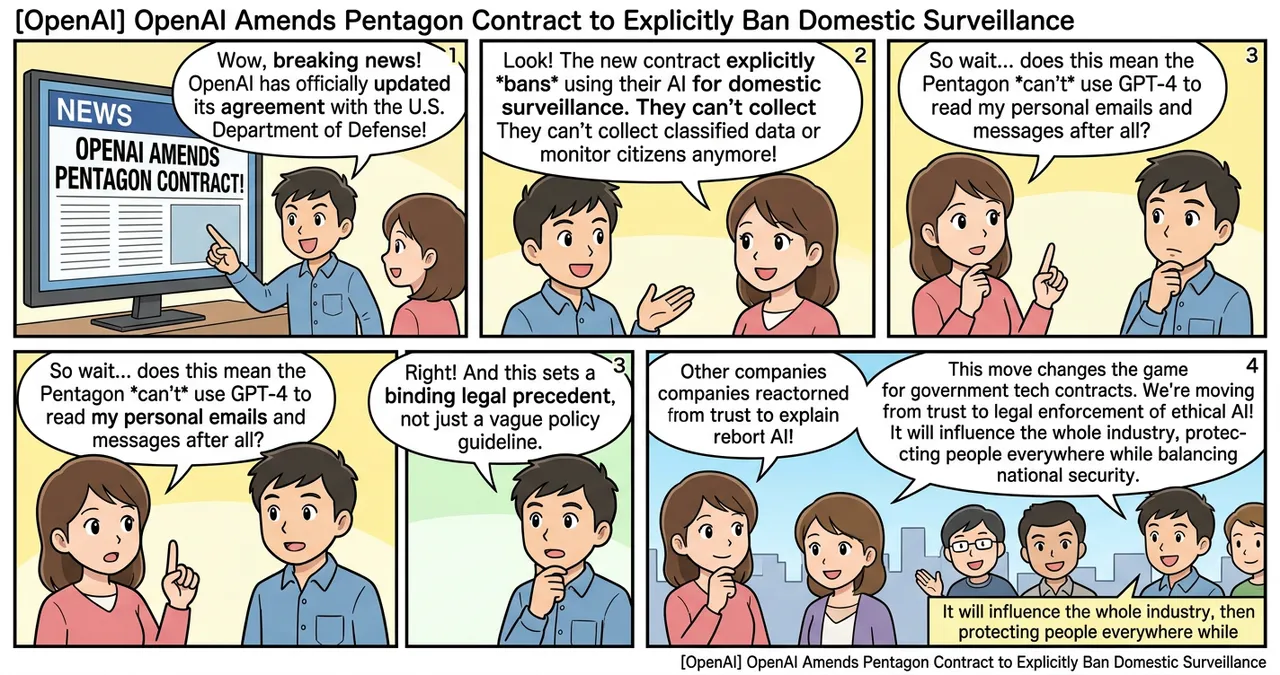
- OpenAI has formally amended its contract with the U.S. Department of Defense (DoD) to include explicit prohibitions against using its models for domestic surveillance.
- The revision specifically bans the collection of classified intelligence, addressing concerns that generative AI could be weaponized for mass monitoring.
- CEO Sam Altman acknowledged that the initial agreement “looked sloppy," leading to this move as a response to significant pushback from employees and the public.
Detailed Breakdown
Formalizing Ethical Boundaries in Defense
The updated agreement between OpenAI and the Pentagon introduces strict legal guardrails that were previously absent or vaguely defined. While OpenAI has historically allowed its technology to be used for non-combat defense purposes—such as software engineering, cybersecurity, and administrative tasks—the lack of specific language regarding surveillance created a policy vacuum. The new contract language serves as a definitive “no-go” zone for applications that involve monitoring citizens or gathering sensitive, classified data.
Addressing Internal and Public Backlash
The decision to refine the contract stems from internal friction within OpenAI. Many employees expressed concern that the company’s “mission-driven” approach to AI safety was being compromised by unclear defense partnerships. By explicitly banning surveillance, OpenAI aims to reconcile its commercial interests with its stated goal of ensuring AI benefits all of humanity. This move follows a broader industry trend where tech workers demand transparency regarding how their tools are utilized by government agencies.
The Shift from General Use to Restricted Application
Previously, OpenAI’s usage policies prohibited “military and warfare” applications in a broad sense. However, as the company deepened its ties with the DoD, those policies were updated to be more granular. The latest amendment clarifies that while the Pentagon can use GPT-4 for “defensive” operations—such as identifying vulnerabilities in code—it cannot bridge into the realm of intelligence gathering or active surveillance of the domestic population.
Why Is This Significant?
The significance lies in the transition from a “gentleman’s agreement” on ethical use to a binding legal framework. Below is a comparison of the approach before and after the contract amendment:
| Feature | Previous Stance | New Amended Contract |
|---|---|---|
| Surveillance | Not explicitly mentioned in DoD context | Explicitly prohibited (Domestic) |
| Intelligence Gathering | Ambiguous under “General Use” | Banned for classified collection |
| Enforcement | Internal policy guidelines | Contractual obligation with the DoD |
| Public Perception | Viewed as “sloppy” or vague | Positioned as a transparent ethical boundary |
This change sets a precedent for how AI companies negotiate with state actors. It acknowledges that general-purpose models are “dual-use” technologies that require specific limitations to prevent misuse in sensitive geopolitical contexts.
Impact on the Tech Industry
For the broader tech ecosystem, this development signals a cooling period for unrestricted government contracts. Engineers and AI researchers at competing firms, such as Anthropic or Google, may leverage this precedent to demand similar clauses in their own government agreements.
Furthermore, this move establishes a “compliance blueprint” for startups. As smaller AI firms look to land government contracts, they will likely face pressure to include surveillance bans from the outset to avoid the PR challenges and internal unrest that OpenAI experienced. It highlights that technical capabilities are no longer the only factor in government procurement; ethical alignment and contractual clarity are becoming equally vital.
Points to Consider
While the amendment is a step toward transparency, several objective challenges remain:
- Definition of “Surveillance”: The technical definition of what constitutes “surveillance” versus “data analysis” can be fluid. Distinguishing between analyzing public data for security and monitoring individuals for surveillance requires precise technical auditing.
- Enforcement Mechanisms: It remains unclear how OpenAI will monitor the Pentagon’s internal use of its API or fine-tuned models to ensure compliance without infringing on the DoD’s own operational security.
- International Precedent: While this ban applies to the U.S. Department of Defense, it raises questions about how OpenAI will handle similar contracts with foreign governments or international security coalitions.
Try It Yourself
While most users are not negotiating defense contracts, you can take steps to understand and monitor these ethical boundaries:
- Review OpenAI’s Usage Policy: Visit the official OpenAI website to read the “Prohibited Uses” section, which is periodically updated to reflect these contractual changes.
- Monitor Federal Procurement Records: Use tools like USASpending.gov to track the scale and nature of contracts between AI companies and government agencies.
- Analyze Model Behavior: If you are a developer, test the safety filters of GPT models regarding requests related to sensitive data collection to see how the “guardrails” are implemented at a technical level.
Summary
OpenAI’s decision to explicitly ban domestic surveillance in its Pentagon contracts marks a pivotal shift toward accountability in the “dual-use” AI era. By correcting what was described as a “sloppy” initial agreement, the company is attempting to balance national security support with fundamental privacy protections. The long-term success of this policy will depend on how rigorously these contractual boundaries are monitored and enforced in practice.
Why It Matters
This news represents a critical juncture where the AI industry establishes legal limits on government power. It ensures that generative AI tools remain focused on productivity and defense rather than becoming instruments for state-sponsored domestic monitoring, directly impacting the privacy rights of millions.
Primary Sources
Glossary
- Domestic Surveillance: The monitoring of citizens within a country’s own borders by government agencies, often involving the collection of communication or behavioral data.
- Dual-Use Technology: Software or hardware that can be used for both peaceful civilian purposes and military or destructive applications.
- Classified Intelligence: Highly sensitive information that a government body deems necessary to protect for national security reasons, often restricted to specific clearance levels.
![[OpenAI] OpenAI to Deploy AI Models on Pentagon's Classified Networks](https://4koma-news.com/images/posts/en/73-2026-02-28-openai-dod-ai-models-blog.webp)
![[Weekly AI Model Updates] Top 5 News to Watch (3/8 - 3/15)](https://4koma-news.com/images/posts/en/90-weekly-ai-news-model-2026-03-15-blog.webp)
![[Cybersecurity] OpenAI Launches Codex Security: An Autonomous Agent for Vulnerability Management](https://4koma-news.com/images/posts/en/88-2026-03-07-openai-codex-security-blog.webp)
![[Weekly AI Model Updates] Top 5 News to Watch (3/15 - 3/22)](https://4koma-news.com/images/posts/en/90-weekly-ai-news-model-2026-03-22-blog.webp)

