

Key Takeaways
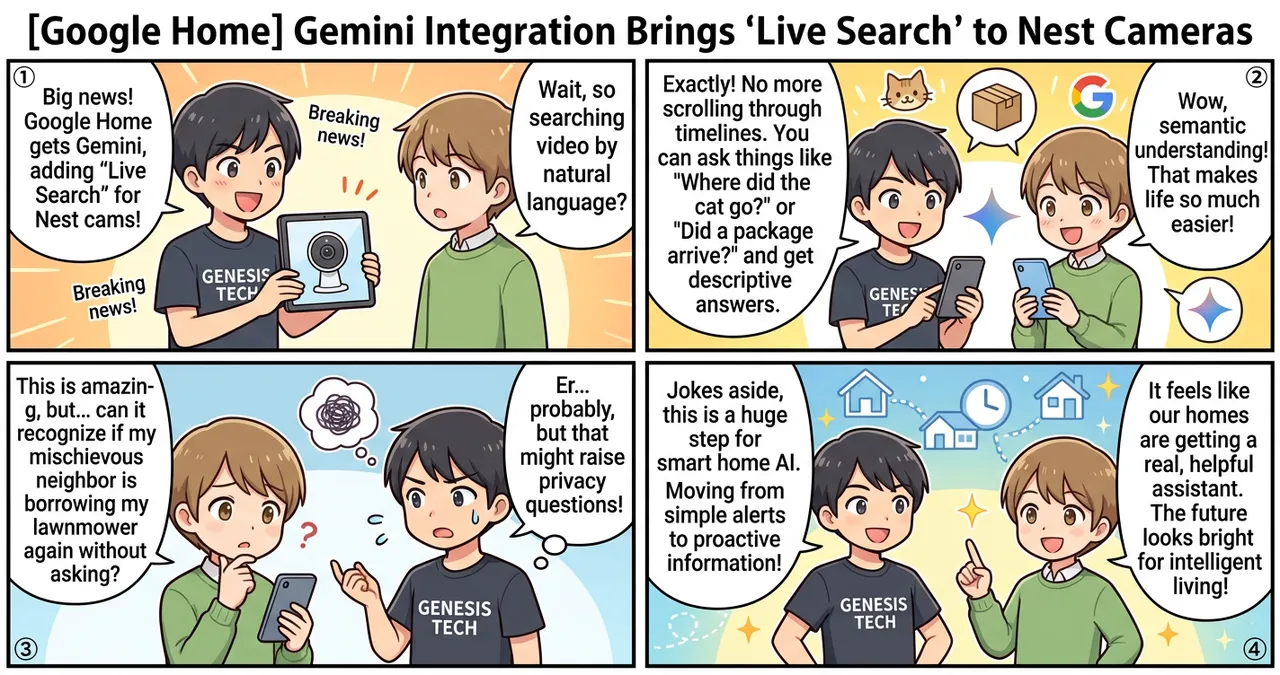
- Gemini-powered Live Search allows users to query Nest camera footage using natural language instead of scrolling through timelines.
- The system moves beyond basic motion detection to semantic understanding, identifying specific events like a dog playing in a specific area.
- The feature is initially rolling out to Nest Aware subscribers within the Google Home Public Preview program.
Detailed Breakdown
Natural Language Video Querying
The core of this update is the transition from metadata-based filtering to semantic search. Previously, users could only filter events by broad categories such as “Person,” “Animal,” or “Vehicle.” With the Gemini integration, the Google Home app can now process specific questions. For example, a user can ask, “Did the kids leave their bikes on the driveway?” and the AI will analyze the relevant footage to provide a descriptive answer.
Multimodal Analysis
The “Live Search” feature utilizes Gemini’s multimodal capabilities to understand the context of visual data. It does not just recognize an object; it interprets the relationship between objects and their actions over time. This allows the system to distinguish between a delivery person leaving a package and a neighbor simply walking past the house.
Enhanced Automation through Scripting
Beyond search, Google is utilizing Gemini to assist with home automation. The update includes tools that help users generate complex home automation scripts using natural language. This lowers the barrier to entry for advanced smart home setups, allowing users to describe a desired behavior—such as “Dim the lights and lock the door when the TV turns on after 8 PM”—which the AI then converts into functional code.
Why Is This Significant?
This update represents a fundamental shift in how smart home data is utilized. Traditional smart cameras are “reactive,” sending alerts based on simple triggers. Gemini transforms these cameras into “proactive” information sources that can be interrogated.
| Feature | Traditional Smart Cameras | Gemini-Enabled Home App |
|---|---|---|
| Detection Logic | Pixel-based motion or basic object tags | Semantic video understanding |
| User Interface | Manual timeline scrolling | Natural language chat interface |
| Contextual Awareness | Low (notices “movement”) | High (understands “playing” or “waiting”) |
| Searchability | Limited to time and event type | Deep search across historical footage |
The technical significance lies in the deployment of Large Language Models (LLMs) and Vision Language Models (VLMs) at the consumer level. By offloading the heavy lifting of video interpretation to Gemini, Google eliminates the need for users to manually review hours of footage, effectively turning the smart home into a searchable database.
Impact on the Tech Industry
For engineers and companies in the IoT space, this move signals the end of the “simple sensor” era. Competitors like Amazon (Ring) and Apple (HomeKit) will likely face increased pressure to integrate similar generative AI features to keep their ecosystems competitive.
Furthermore, this deployment highlights the growing importance of cloud-to-edge synchronization. While basic detection might happen on-device, the complex semantic reasoning provided by Gemini requires significant cloud resources. This sets a precedent for subscription-based “AI-as-a-Service” models in the hardware industry, where the value of a physical product is continuously enhanced by server-side software updates.
Points to Consider
While the functionality is a significant leap forward, several factors warrant objective observation. Privacy remains a primary concern, as the system requires the AI to “watch” and interpret private video feeds to answer questions. Google has stated that these features are opt-in and data is protected, but the depth of analysis may be a hurdle for privacy-conscious users.
Additionally, the accuracy of semantic search—often referred to as the “hallucination” problem in LLMs—must be monitored. In complex outdoor environments with shadows or overlapping movements, the AI might misinterpret specific actions. Finally, the requirement for a Nest Aware subscription and the Public Preview status means the full utility of the feature is currently limited to a specific subset of the user base.
Try It Yourself
If you own a Nest camera and wish to test the new Gemini features, follow these steps:
- Join the Public Preview: Open the Google Home app, go to Settings, and select “Public Preview” to opt-in.
- Ensure Subscription: Confirm you have an active Nest Aware subscription, as the AI features are tied to recorded event history.
- Access the Activity Tab: Once the update is active, navigate to the “Activity” tab where the new search bar will appear.
- Test Queries: Try specific questions such as “Did the dog go on the couch today?” or “When did the mail arrive?” to see the AI’s descriptive response.
Summary
Google’s integration of Gemini into the Home app marks a transition from simple motion alerts to sophisticated, searchable video intelligence. By allowing users to interact with their camera feeds using natural language, Google is redefining the utility of smart home surveillance. As these models evolve, the smart home will increasingly function as an intuitive assistant capable of understanding and reporting on the physical world.
Why It Matters
This development moves AI from a text-based chatbot into a practical tool for physical security and household management. It demonstrates how multimodal AI can solve real-world frustrations, such as searching through hours of video, by giving the software the ability to “see” and “describe” events like a human would.
Primary Sources
- T3: Google just upgraded its Home app with Gemini features
- Google Nest Help: Join the Public Preview for Google Home
Glossary
- Gemini: Google’s family of multimodal large language models capable of understanding text, images, and video.
- Multimodal AI: AI systems that can process and relate information from multiple types of data, such as combining visual video data with natural language text.
- Nest Aware: A subscription service for Google Nest products that provides extended video history and advanced intelligent alerts.
- Public Preview: A testing phase where users can opt-in to try new features before they are officially released to the general public.
![[Weekly AI Model Updates] Top 5 News to Watch (3/1 - 3/8)](https://4koma-news.com/images/posts/en/88-weekly-ai-news-model-2026-03-08-blog.webp)
![[Gemini Lawsuit] Google Faces Wrongful Death Legal Action Over Chatbot Interactions](https://4koma-news.com/images/posts/en/87-2026-03-04-google-gemini-wrongful-death-blog.webp)
![[Gemini 3.1 Flash-Lite] Google’s New Ultra-Fast, Low-Cost Model](https://4koma-news.com/images/posts/en/85-2026-03-03-google-gemini-flash-lite-blog.webp)
![[Weekly AI Model Updates] Top 5 News to Watch (2/22 - 3/1)](https://4koma-news.com/images/posts/en/80-weekly-ai-news-model-2026-03-01-blog.webp)

