

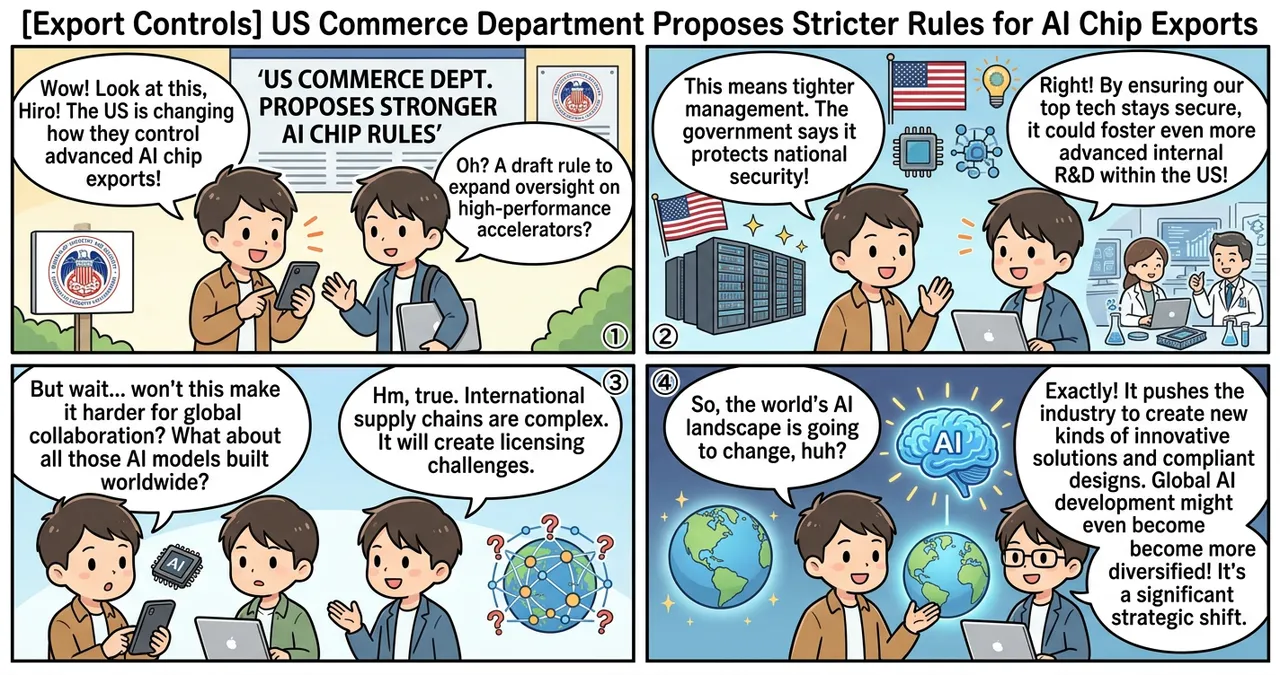
Key Takeaways
- Expanded federal oversight will now apply to a broader range of AI accelerators and high-performance computing chips.
- Major manufacturers including NVIDIA and AMD face stricter licensing requirements for international shipments.
- The draft rule signals a tightening of export management policies under the current administration to protect national security interests.
Detailed Breakdown
Expansion of the Bureau of Industry and Security (BIS) Authority
The U.S. Department of Commerce, through the Bureau of Industry and Security (BIS), has released a draft regulation intended to refine and expand the scope of existing export controls. This move signifies a shift from targeting specific performance metrics to a more comprehensive monitoring of the entire AI hardware ecosystem. The rule aims to close loopholes that previously allowed certain “stripped-down” versions of high-end chips to be exported without rigorous federal review.
Targeted Hardware and Technologies
The proposed regulations focus on advanced integrated circuits (ICs) specifically designed for AI training and inference. While previous rules primarily targeted the highest tier of GPUs, the new draft encompasses a wider variety of AI accelerators, including custom-designed ASICs (Application-Specific Integrated Circuits). This ensures that emerging technologies used in large-scale data centers are subject to the same level of scrutiny as established products from industry leaders.
Regulatory Direction and Compliance
Under the new framework, exporters must navigate more complex licensing processes. The government intends to implement a “presumption of denial” for exports to certain regions, placing the burden of proof on the companies to demonstrate that their hardware will not be used for unauthorized military or surveillance purposes. This regulatory trajectory reflects a long-term strategy to maintain a technological lead in the global AI landscape.
Why Is This Significant?
The transition from the previous regulatory environment to this new draft rule represents a fundamental change in how the U.S. manages its technological assets. The following table highlights the key differences between the existing framework and the proposed changes:
| Feature | Previous Approach | New Proposed Rule |
|---|---|---|
| Primary Metric | Computing power thresholds (e.g., TFLOPS) | Comprehensive end-use and hardware architecture |
| Product Scope | High-end flagship GPUs only | Wide range of AI accelerators and custom chips |
| Licensing | Case-by-case exceptions | Broad federal oversight with stricter mandates |
| Geographic Focus | Targeted nations | Expanded list of regions requiring scrutiny |
By moving toward a more holistic oversight model, the U.S. government seeks to prevent the diversion of technology through third-party intermediaries. This approach prioritizes national security over immediate commercial interests, emphasizing the strategic importance of AI hardware as a foundational element of modern power.
Impact on the Tech Industry
For engineers and hardware designers, these regulations necessitate a shift in product development cycles. Companies may need to design specialized “export-compliant” variants from the ground up rather than modifying existing high-end products. This adds significant R&D costs and complicates the global supply chain for AI infrastructure.
Data center operators and cloud service providers outside the U.S. may face delays in acquiring the latest hardware, potentially slowing the pace of AI model training in certain regions. Conversely, this may incentivize the development of domestic semiconductor industries in countries affected by the restrictions, leading to a more fragmented global hardware market.
Points to Consider
While the draft rule aims to enhance security, several challenges remain. The enforcement of these rules requires international cooperation, as many components of the AI supply chain are distributed globally. Monitoring the final destination of chips after they leave the primary manufacturer remains a difficult task for federal agencies.
Furthermore, there is an ongoing debate regarding the balance between security and innovation. Overly restrictive measures could inadvertently hinder collaborative research and development in the private sector. The industry must also prepare for potential retaliatory measures from trading partners, which could impact the availability of raw materials necessary for semiconductor manufacturing.
Try It Yourself
- Monitor the Federal Register: Keep an eye on official Bureau of Industry and Security (BIS) announcements to track when the draft rule becomes final.
- Review Compliance Documentation: If you work for a tech firm, consult with legal counsel to understand how revised Export Control Classification Numbers (ECCN) affect your products.
- Analyze Market Reports: Follow the quarterly earnings calls of major chipmakers like NVIDIA and AMD to see how they are adjusting their revenue projections in light of these regulations.
Summary
The U.S. Commerce Department’s draft rule marks a significant escalation in the control of AI hardware exports, moving toward a more comprehensive oversight model. By targeting a broader range of accelerators and tightening licensing requirements, the government aims to safeguard critical technological advantages. The future of the AI industry will likely be shaped by how effectively companies can navigate this increasingly complex regulatory landscape.
Why It Matters
This development is a critical turning point for the AI industry, as it directly influences the global distribution of computing power. It forces a decoupling of supply chains and necessitates new strategies for hardware innovation and international trade compliance.
Primary Sources
- U.S. Department of Commerce: Bureau of Industry and Security Official Site
- Federal Register: Proposed Rulemaking on Advanced Computing Exports
Glossary
- AI Accelerator: A specialized hardware component designed to accelerate the processing of artificial intelligence and machine learning workloads.
- BIS (Bureau of Industry and Security): An agency within the U.S. Department of Commerce that deals with issues involving national security and high technology.
- Export Control Classification Number (ECCN): An alphanumeric designation used to identify items for export control purposes.
- ASIC (Application-Specific Integrated Circuit): A microchip designed for a special application, such as a particular kind of transmission protocol or a hand-held computer.
![[Weekly AI Industry & Trends] Top 5 News to Watch (3/8 - 3/15)](https://4koma-news.com/images/posts/en/91-weekly-ai-news-other-2026-03-15-blog.webp)
![[Anthropic Ban] US Military Reportedly Uses Anthropic AI for Airstrikes Hours After Executive Ban](https://4koma-news.com/images/posts/en/79-2026-03-01-anthropic-us-airstrike-blog.webp)
![[OpenAI] OpenAI Raises $110B as Valuation Soars to $730B](https://4koma-news.com/images/posts/en/72-2026-02-28-openai-funding-valuation-blog.webp)