
Key Takeaways
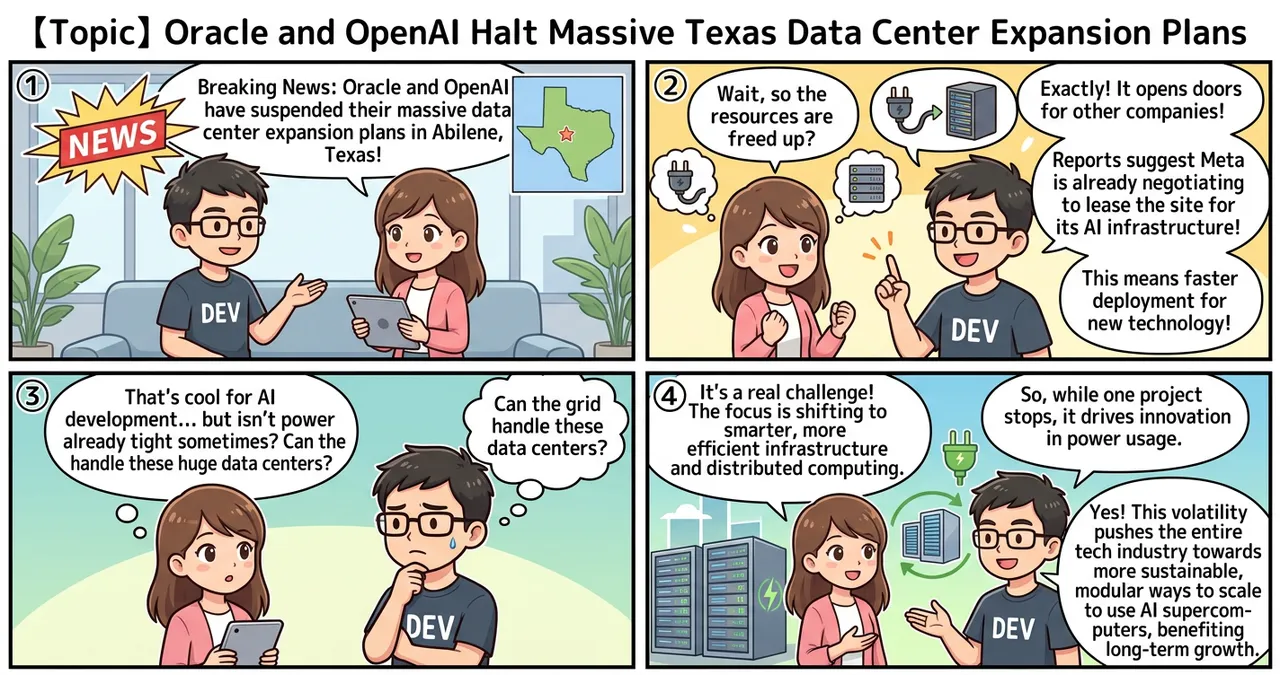
- Oracle and OpenAI have suspended their ambitious plans to expand a massive data center facility in Abilene, Texas, which was previously linked to the $100 billion “Stargate” project.
- Meta has reportedly entered the scene, starting negotiations with developers to lease the same site for its own rapidly growing AI infrastructure needs.
- This development underscores the volatility and high stakes of securing physical space and power capacity in the race to build next-generation AI supercomputers.
Detailed Breakdown
The Suspension of the Abilene Project
Oracle and OpenAI had been collaborating on a significant expansion in Abilene, Texas. This site was intended to house massive clusters of GPUs required for training the next iterations of OpenAI’s large language models. The project was frequently discussed in the context of “Stargate,” a multi-phase plan to build one of the world’s largest AI supercomputers. However, reports indicate that the two companies have decided to halt these specific expansion efforts. While the exact reasons for the pause remain undisclosed, industry analysts point toward logistical complexities or a strategic shift in how the companies distribute their computing resources.
Meta’s Strategic Pivot
Following the withdrawal of Oracle and OpenAI, Meta (the parent company of Facebook and Instagram) has moved quickly. The company is currently in discussions with the project developers to lease the Abilene site. Meta has been aggressively scaling its infrastructure to support the training of its Llama series of models and the integration of AI across its social media platforms. By stepping into a project where ground has already been broken or planning is advanced, Meta could significantly shorten its timeline for deploying new hardware.
Infrastructure and Power Challenges
The Abilene site is significant because of its access to the Texas power grid, managed by ERCOT. Large-scale data centers require hundreds of megawatts—and eventually gigawatts—of electricity. The competition for sites with ready access to high-voltage transmission lines has become a primary bottleneck for AI companies. The shift from Oracle/OpenAI to Meta highlights that the “real estate” of the AI era is defined less by location and more by power availability.
Why Is This Significant?
The transition of this site from one AI giant to another reveals a shift in the “buy vs. build” and “centralize vs. distribute” strategies of major tech firms.
| Feature | Oracle/OpenAI (Original Plan) | Meta (Potential New Plan) |
|---|---|---|
| Project Focus | Specialized “Stargate” supercomputer | General-purpose AI & Llama training |
| Scale | Multi-phase, extremely high density | Rapid deployment of existing H100/B100 clusters |
| Infrastructure | Custom liquid cooling for high-end chips | Standardized hyperscale architecture |
| Strategic Goal | Achieving AGI through massive scale | Enhancing consumer AI and ad-targeting |
Securing a site that has already undergone preliminary development or zoning is a massive advantage. For Meta, this represents an opportunity to bypass the early-stage regulatory and environmental hurdles that often delay data center construction by years.
Impact on the Tech Industry
For engineers and tech companies worldwide, this news signals that the physical constraints of AI are becoming as important as the algorithmic ones. As companies like OpenAI and Meta compete for the same land and power, the cost of infrastructure is expected to rise. This may lead to a “geographic gold rush” where companies look toward unconventional regions with untapped energy resources.
Furthermore, this move suggests that even the largest partnerships, such as Oracle and OpenAI, are not immune to the challenges of scaling at this unprecedented magnitude. Engineers may see a shift toward more modular and distributed training methods if single-site “mega-clusters” prove too difficult to build or maintain in the current economic and regulatory environment.
Points to Consider
While Meta’s entry into the Abilene project suggests a continuation of AI growth, there are several factors to watch objectively:
- Grid Stability: The Texas power grid has faced scrutiny regarding its reliability during extreme weather. Adding another massive consumer could lead to increased regulatory oversight or demands for onsite power generation (such as nuclear or natural gas).
- Supply Chain Fluidity: A change in the lead tenant of a data center often requires changes to the hardware specifications, which can ripple through the supply chains of cooling systems and electrical switchgear.
- Strategic Relocation: It is unclear if OpenAI is scaling back its total computing goals or simply moving the “Stargate” project to a different location with better incentives or infrastructure.
Try It Yourself
To better understand the scale and impact of these infrastructure shifts, you can take the following steps:
- Track Data Center REITs: Follow companies like Equinix or Digital Realty to see how vacancy rates and power availability are trending in major hubs.
- Monitor ERCOT Load Reports: Visit the ERCOT website to view public data on industrial power demand in Texas and how data centers contribute to the load.
- Explore Meta’s Engineering Blog: Read Meta’s public updates on their “AI Research SuperCluster” (RSC) to understand the technical requirements of the hardware they are likely to install in Texas.
Summary
The halt of the Oracle-OpenAI expansion in Texas marks a notable pivot in the race for AI infrastructure, allowing Meta to potentially secure a high-capacity site. This transition highlights that power availability and site readiness are currently the most valuable commodities in the tech sector. As the industry moves forward, the ability to rapidly adapt infrastructure strategies will be a defining factor in which companies successfully scale their AI capabilities.
Why It Matters
This news illustrates the physical limits of the AI revolution, where land and electricity are now the primary constraints for progress. For society, it signals that the battle for AI dominance is moving from software code to the physical construction of massive, energy-intensive industrial facilities.
Primary Sources
Glossary
- Stargate: A rumored $100 billion supercomputer project planned by Microsoft and OpenAI to push the boundaries of AI training.
- ERCOT: The Electric Reliability Council of Texas, which operates the electrical grid for most of the state of Texas.
- Hyperscale: Refers to the ability of an architecture to scale appropriately as increased demand is added to the system, typically associated with massive data centers used by big tech companies.
![[Weekly AI Model Updates] Top 5 News to Watch (3/15 - 3/22)](https://4koma-news.com/images/posts/en/90-weekly-ai-news-model-2026-03-22-blog.webp)
![[Weekly AI Industry & Trends] Top 5 News to Watch (3/8 - 3/15)](https://4koma-news.com/images/posts/en/91-weekly-ai-news-other-2026-03-15-blog.webp)
![[Weekly AI Model Updates] Top 5 News to Watch (3/8 - 3/15)](https://4koma-news.com/images/posts/en/90-weekly-ai-news-model-2026-03-15-blog.webp)
![[Weekly AI Industry & Trends] Top 5 News to Watch (3/1 - 3/8)](https://4koma-news.com/images/posts/en/89-weekly-ai-news-other-2026-03-08-blog.webp)

