

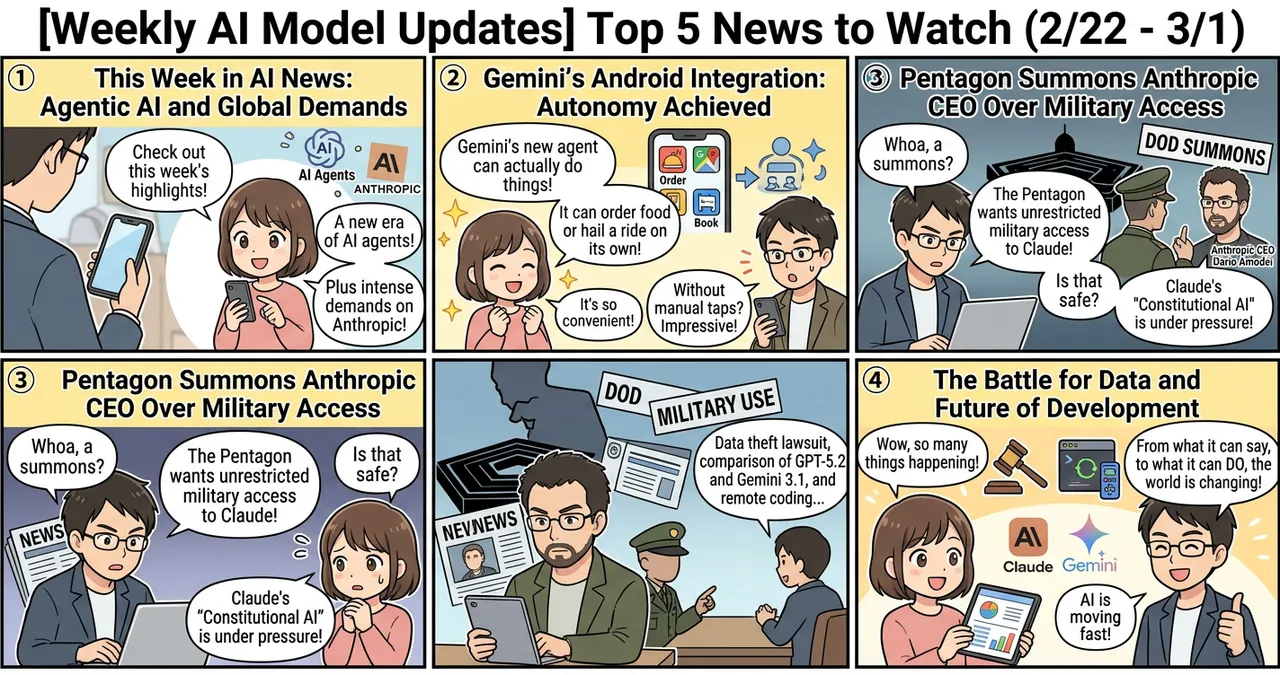
This Week’s Highlights
- Anthropic faces unprecedented pressure from both legal fronts regarding data theft and governmental demands for military integration.
- Google transitions Gemini from a chatbot to an autonomous agent capable of handling real-world tasks on Android devices.
- Developer tools reach a new level of mobility with Claude Code’s remote features, signaling a shift in how engineering work is performed.
1. Pentagon Summons Anthropic CEO Over Military Use of Claude
Key Point: The U.S. government seeks deeper integration of Claude into classified military networks for national security.
The U.S. Department of Defense has officially summoned Anthropic CEO Dario Amodei to discuss the deployment of Claude within classified environments. This move signals a significant shift in the relationship between “safety-focused” AI labs and national defense. The Pentagon is reportedly demanding unrestricted access to the model’s capabilities to maintain a competitive edge in the global AI arms race.
This development highlights the growing tension between a tech company’s private ethics and national interests. As AI becomes a core pillar of modern geopolitics, the pressure on firms like Anthropic to cooperate with military initiatives is likely to intensify. You can read the full details on the Pentagon Summons Anthropic CEO Over Military Use of Claude report.
📎 Source: Pentagon Summons Anthropic CEO Over Military Use of Claude
🇯🇵 日本語解説: 米国防総省がAnthropicに対し、機密ネットワーク上でのClaudeの自由な利用を要求したというニュースです。AI企業の公共性と国家安全保障のバランスが問われており、今後の軍事利用の進展が注目されます。
2. Gemini’s Android Agent Feature: Your Smartphone Now Completes Tasks Autonomously
Key Point: Google’s Gemini can now autonomously handle food orders and ride-hailing directly on Android.
Google has launched a preview of its new agent feature for Gemini, marking a major milestone in the evolution of smartphones. Unlike traditional voice assistants that simply provide information, these agents can navigate apps to complete complex tasks like ordering dinner or booking a ride. This represents a fundamental shift from “AI as an interface” to “AI as an actor.”
The integration of agentic capabilities into the Android OS suggests that the future of mobile interaction will be largely hands-free. While currently in preview, this feature sets a high bar for competitors like Apple and OpenAI to follow. For a deeper look, check out our coverage on Gemini’s Android Agent Feature.
📎 Source: Gemini’s Android Agent Feature: Your Smartphone Now Completes Tasks Autonomously
🇯🇵 日本語解説: GeminiがAndroid上で自律的にアプリを操作し、食事の注文や配車予約を代行するエージェント機能のプレビューが開始されました。単なる対話型AIから、実務をこなす「自律型エージェント」への大きな転換点となります。
3. Anthropic Sues Three Chinese AI Firms Over 16 Million Data Points Stolen From Claude
Key Point: Anthropic alleges massive data extraction via 24,000 fake accounts to train competing models.
Anthropic has initiated a major lawsuit against three Chinese AI companies, alleging the illegal extraction of 16 million data points from the Claude model. The lawsuit claims that these firms used tens of thousands of automated accounts to “scrape” high-quality model outputs to refine their own LLMs. This case could set a vital legal precedent for intellectual property rights in the age of generative AI.
The scale of the theft underscores how valuable high-quality model outputs have become for training. As companies strive for better benchmarks, the battle over “synthetic data” and data ownership is becoming increasingly litigious. More details are available in the article Anthropic Sues Three Chinese AI Firms Over 16 Million Data Points Stolen From Claude.
📎 Source: Anthropic Sues Three Chinese AI Firms Over 16 Million Data Points Stolen From Claude
🇯🇵 日本語解説: Anthropicが、Claudeから大量のデータを不正抽出したとして中国企業3社を提訴しました。モデルの出力を他社の学習に流用する行為に対する法的措置であり、AI業界における知的財産保護の重要な判例となる可能性があります。
4. Claude Code’s New ‘Remote Control’ Feature: Continue Development From Any Device
Key Point: Developers can now bridge local coding sessions to mobile devices via a secure browser link.
Anthropic has updated its Claude Code tool with a “Remote Control” feature, allowing engineers to maintain their development momentum across different hardware. By enabling a secure remote session, a developer can start a task on a high-powered workstation and finish it on a smartphone or tablet. This feature is part of a broader push to make AI-assisted engineering more flexible and accessible.
This update reflects the changing nature of software engineering, where the environment is no longer tied to a single machine. For those interested in how this changes the workflow, see our deep dive on Claude Code’s New ‘Remote Control’ Feature.
📎 Source: Claude Code’s New ‘Remote Control’ Feature: Continue Development From Any Device
🇯🇵 日本語解説: Claude Codeに、ローカルの開発セッションをスマホなどの他デバイスから継続できる「リモートコントロール」機能が追加されました。デバイスを問わずAIエージェントと共に開発を続けられる、柔軟なワークフローを実現します。
5. Claude Code vs ChatGPT vs Gemini: A 2026 Comparison for Non-Engineers
Key Point: A comprehensive look at how the top AI tools stack up for non-technical users in 2026.
As AI tools become more specialized, choosing the right platform can be daunting for non-engineers. This latest comparison evaluates Claude Code against established giants like Gemini 3.1 Pro and GPT-5.2. The analysis focuses on ease of use, the effectiveness of “Cowork” features for non-technical users, and how these models handle everyday productivity tasks rather than just raw code.
While Claude Code is making waves in the developer community, Google’s ecosystem and OpenAI’s general-purpose flexibility remain strong contenders. For a full breakdown of which tool fits your needs, read Claude Code vs ChatGPT vs Gemini: A 2026 Comparison for Non-Engineers.
📎 Source: Claude Code vs ChatGPT vs Gemini: A 2026 Comparison for Non-Engineers
🇯🇵 日本語解説: 非エンジニア向けに、Claude Code、GPT-5.2、Gemini 3.1 Proの最新機能を比較したガイドです。各社のエージェント機能や使い勝手の違いがまとめられており、自分に最適なツールを選ぶための指標になります。
Weekly Summary
This week showed us that the AI landscape in 2026 is defined by two parallel tracks: heavy-duty geopolitical maneuvering and rapid consumer-facing innovation. While Anthropic navigates complex legal and military waters, Google is successfully bringing the “AI Agent” dream to the pockets of millions of Android users.
As we look forward, the release of high-speed models like [Nano Banana 2] Google Releases High-Speed Image Generation Model Nano Banana 2 suggests that efficiency will be the next major battleground for model updates. Stay tuned as these technologies continue to converge and redefine our daily digital lives.
![[Weekly AI Model Updates] Top 5 News to Watch (3/1 - 3/8)](https://4koma-news.com/images/posts/en/88-weekly-ai-news-model-2026-03-08-blog.webp)
![[Weekly AI Model Updates] Top 5 News to Watch (3/15 - 3/22)](https://4koma-news.com/images/posts/en/90-weekly-ai-news-model-2026-03-22-blog.webp)
![[Weekly AI Industry & Trends] Top 5 News to Watch (3/1 - 3/8)](https://4koma-news.com/images/posts/en/89-weekly-ai-news-other-2026-03-08-blog.webp)
![[Anthropic Claude] Anthropic's Claude AI Recovers After Major Global System Outage](https://4koma-news.com/images/posts/en/82-2026-03-02-claude-system-outage-blog.webp)

