

This Week’s Highlights
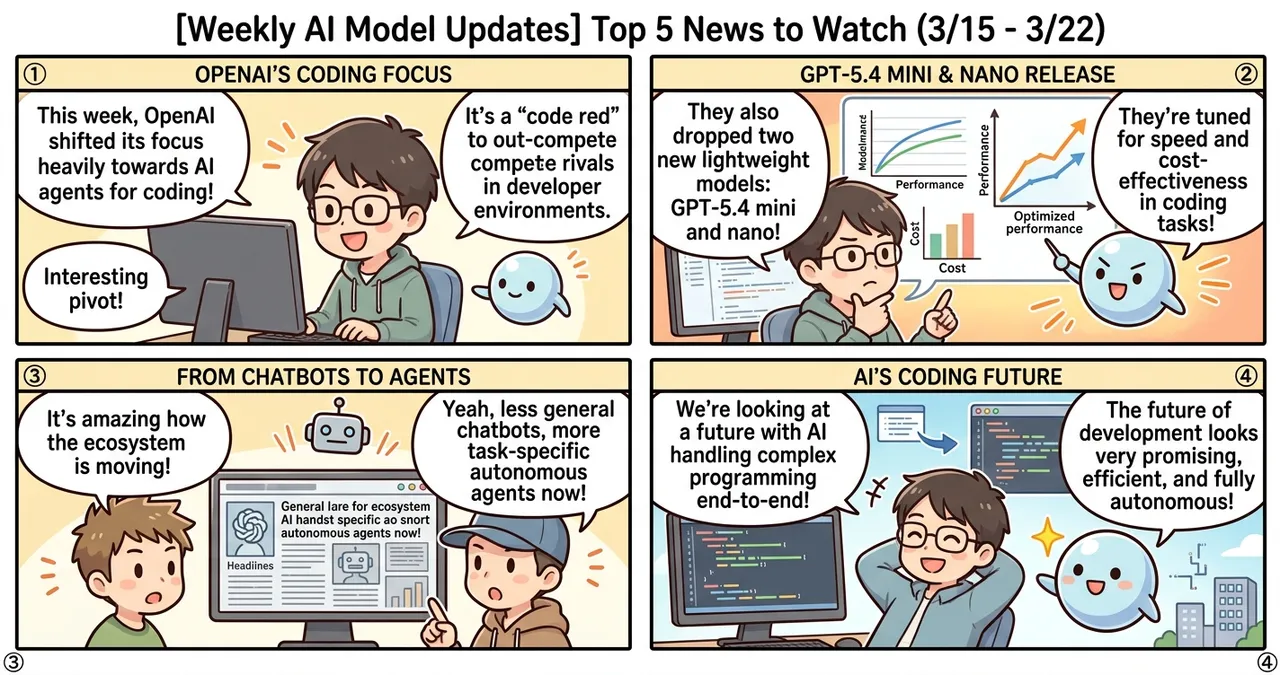
- OpenAI shifts strategic focus toward specialized coding agents to compete with rising industry rivals.
- The release of GPT-5.4 mini and nano models provides high-efficiency tools for developer workflows.
- The ecosystem is rapidly moving from general-purpose chatbots to task-specific autonomous agents.
1. OpenAI shifts strategy to focus on coding agents
Key Point: OpenAI launches “code red” initiative to prioritize deep integration of AI agents into developer environments.
Facing stiff competition from tools like Anthropic’s Claude Code, OpenAI is reallocating significant resources to dominate the coding assistant market. This strategic pivot, internally dubbed “code red,” signals a move away from broad feature expansion toward creating highly specialized, integrated developer tools.
The industry impact will likely be significant, as OpenAI seeks to redefine the standard for autonomous coding agents. By focusing on deep environment integration, the company aims to move beyond simple code completion into fully autonomous software engineering workflows.
📎 Source: note.com
🇯🇵 日本語解説: OpenAIが競合の台頭を受け、コーディングエージェント開発へ経営資源を集中させる方針を固めました。単なる生成支援を超え、開発環境に深く統合された自律的なエージェント構築が、今後のAI開発の主戦場となることを示唆しています。
2. OpenAI releases GPT-5.4 mini and nano models
Key Point: New lightweight models offer optimized performance for coding tasks and cost-effective sub-agent operations.
OpenAI has expanded the GPT-5.4 family with two new additions: the “mini” for balanced speed and efficiency, and the “nano” as the smallest, most cost-effective option in the lineup. These models are specifically tuned for high-frequency tasks such as code generation and acting as sub-agents within larger systems.
These releases are critical for developers looking to minimize latency and operational costs. By providing a tiered model structure, OpenAI allows teams to select the right model for specific tasks, ensuring that expensive compute resources are reserved only for complex problem-solving.
📎 Source: ITmedia
🇯🇵 日本語解説: GPT-5.4シリーズに、軽量で高速なminiとnanoが追加されました。これらは特にコーディングやサブエージェント用途に最適化されており、開発者はコストと速度のバランスを考慮した柔軟なモデル選定が可能になります。
Weekly Summary
This week has been defined by OpenAI’s aggressive push into the coding agent space. By balancing the release of highly efficient, lightweight models with a strategic shift toward specialized developer tools, the organization is clearly preparing for a future where AI handles complex end-to-end programming tasks. Developers should keep a close eye on how these agents integrate with existing IDEs in the coming months. 🚀
[Internal Article Links] (関連する自社記事はありません)
![[Weekly AI Model Updates] Top 5 News to Watch (3/8 - 3/15)](https://4koma-news.com/images/posts/en/90-weekly-ai-news-model-2026-03-15-blog.webp)
![[Weekly AI Model Updates] Top 5 News to Watch (2/22 - 3/1)](https://4koma-news.com/images/posts/en/80-weekly-ai-news-model-2026-03-01-blog.webp)
![[Weekly AI Industry & Trends] Top 5 News to Watch (3/1 - 3/8)](https://4koma-news.com/images/posts/en/89-weekly-ai-news-other-2026-03-08-blog.webp)
![[Weekly AI Industry & Trends] Top 5 News to Watch (2/22 - 3/1)](https://4koma-news.com/images/posts/en/81-weekly-ai-news-other-2026-03-01-blog.webp)

