

This Week’s Highlights
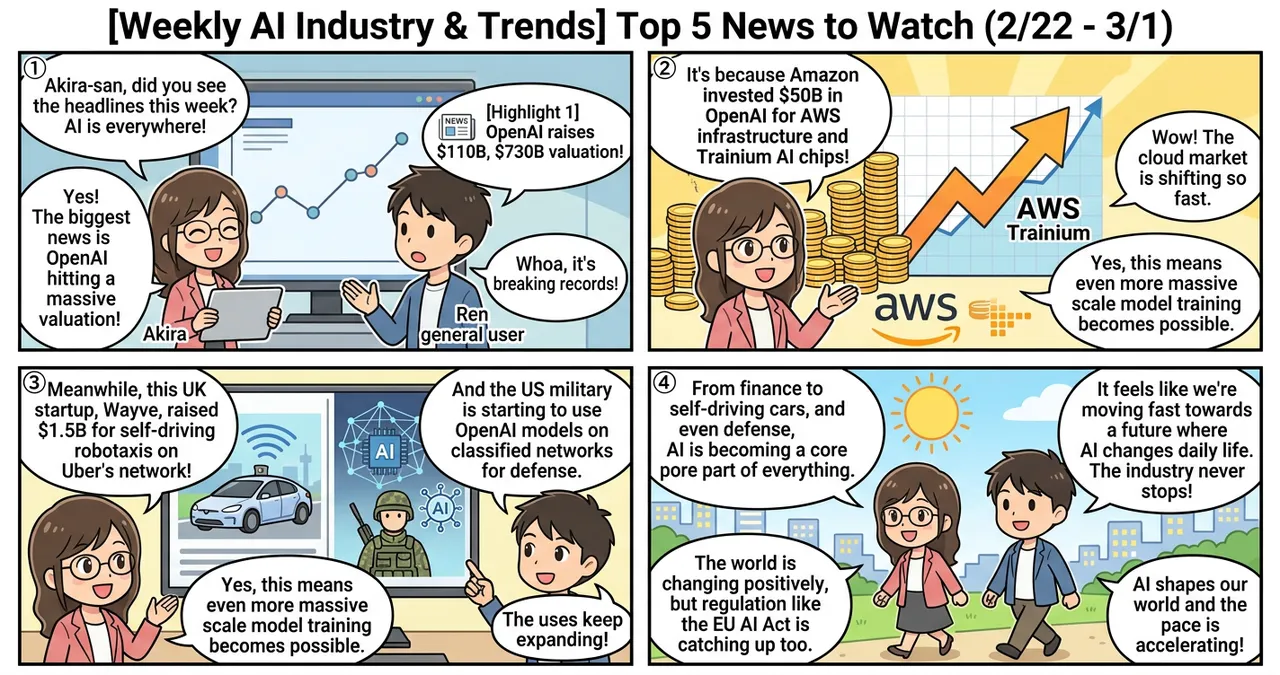
- OpenAI reaches a staggering $730 billion valuation following a historic $110 billion funding round to fuel AGI development.
- The intersection of AI and national security deepens as OpenAI begins deploying models on the Pentagon’s classified networks.
- Global governance and regional regulations solidify with the New Delhi Declaration and the EU’s first draft on AI transparency.
1. OpenAI Raises $110B as Valuation Soars to $730B
Key Point: OpenAI secures a record-breaking $110 billion in funding to accelerate the path toward AGI.
In an unprecedented show of financial force, OpenAI has secured $110 billion in a new funding round, bringing its total valuation to a massive $730 billion. This capital injection, supported by industry titans like Nvidia, SoftBank, and Amazon, is designed to provide the computational resources and talent necessary to achieve Artificial General Intelligence (AGI). This move follows recent reports that OpenAI Raises $110B as Valuation Soars to $730B and aligns with Amazon’s massive $50 billion investment to deepen their strategic partnership.
The scale of this investment suggests that the cost of staying at the frontier of AI development is increasing exponentially. By securing such a vast treasury, OpenAI positions itself to outpace competitors in training larger, more capable models while building out the necessary physical infrastructure. This funding round effectively reshapes the venture capital landscape, making OpenAI one of the most valuable private entities in history.
📎 Source: [OpenAI] OpenAI Raises $110B as Valuation Soars to $730B
🇯🇵 日本語解説: OpenAIが1100億ドルの資金調達を実施し、企業価値が7300億ドルに達しました。NVIDIAやソフトバンク、Amazonからの巨額出資は、AGI(汎用人工知能)実現に向けた計算リソース確保の競争が、かつてない規模に達していることを示しています。
2. OpenAI to Deploy AI Models on Pentagon’s Classified Networks
Key Point: OpenAI partners with the US Department of Defense for secure, military-grade AI deployment.
OpenAI is moving into the defense sector by deploying its AI models on the Pentagon’s classified networks. This partnership marks a significant shift in policy, focusing on enhancing national security through advanced data analysis and cybersecurity. While the collaboration includes strict ethical guardrails to prevent the use of AI in direct kinetic warfare, the move signals a growing acceptance of AI’s role in the “backbone” of military operations.
This development comes at a sensitive time for the industry. While OpenAI expands its military footprint, other players are facing tighter restrictions, such as the recent designation of Anthropic as a supply chain risk by the US administration. The contrast highlights how different AI labs are navigating the complex landscape of government relations and national security.
📎 Source: [OpenAI] OpenAI to Deploy AI Models on Pentagon’s Classified Networks
🇯🇵 日本語解説: OpenAIが米国国防総省の機密ネットワークにAIモデルを導入します。軍事利用における倫理的ガイドラインを維持しつつ、国家安全保障分野でのAI活用を加速させる方針であり、テック企業と国防当局の連携が新たな段階に入ったと言えます。
3. EU Commission Releases First Draft of AI Transparency Code
Key Point: New guidelines set specific rules for identifying and labeling AI-generated content under the EU AI Act.
The European Commission has taken a major step toward enforcing the EU AI Act by releasing the first draft of its “Code of Practice” for AI transparency. The document outlines how providers of general-purpose AI must label synthetic content—such as images, audio, and text—to ensure users are aware they are interacting with AI. This is a crucial move to combat misinformation and deepfakes as the technology becomes more sophisticated.
The code is expected to be finalized and fully applicable by the end of 2026. For developers and companies operating in the EU, this means that “watermarking” and metadata standards will soon move from being best practices to mandatory legal requirements. This regulation sets a global precedent, likely influencing how other regions, including Vietnam with its first comprehensive AI law, approach the problem of digital authenticity.
📎 Source: EU AI Round-up February 2026
🇯🇵 日本語解説: 欧州委員会がAI生成コンテンツの識別に関する「行動規範」の草案を公開しました。EU AI法に基づき、AIによる画像やテキストに識別表示を義務付ける具体的な指針であり、2026年後半の本格適用に向けて開発者は技術的な対応を迫られることになります。
4. Wayve Raises $1.5 Billion for Self-Driving AI, Led by SoftBank
Key Point: UK-based Wayve secures funding to bring map-free, end-to-end AI to the robotaxi market.
Wayve, a pioneer in “embodied AI,” has raised $1.5 billion in a Series D round led by SoftBank Group, with participation from Nvidia and Microsoft. Unlike traditional self-driving systems that rely on expensive high-definition maps, Wayve utilizes an end-to-end AI approach that learns to drive through observation and reinforcement. This technology is aimed at scaling autonomous driving more quickly across diverse urban environments.
The funding is specifically earmarked for the launch of robotaxi trials in partnership with Uber, slated for later in 2026. This massive investment reinforces the trend of AI moving beyond digital screens and into physical robotics. As noted in our deep dive on Wayve’s funding, the involvement of major tech giants suggests a high level of confidence in the shift toward “mapless” autonomous navigation.
📎 Source: Wayve Raises $1.5 Billion for Self-Driving AI, Led by SoftBank
🇯🇵 日本語解説: ソフトバンク主導でWayveが15億ドルを調達し、地図不要の「エンドツーエンドAI」による自動運転の開発を加速させます。2026年のUberとのロボタクシー実用化を目指しており、AIが物理世界を制御する「自律走行」分野での競争が激化しています。
5. India AI Impact Summit 2026 Adopts “New Delhi Declaration”
Key Point: 88 countries agree on a framework for equitable AI distribution and inclusive growth.
The India AI Impact Summit 2026 concluded with the adoption of the “New Delhi Declaration,” a landmark document focused on making AI benefits accessible to the Global South. The summit emphasized that AI should not be a tool for increasing the digital divide, but rather a bridge for education, healthcare, and economic development in emerging nations.
However, the summit also highlighted a growing rift in global governance. While many nations signed on to the inclusivity goals, there was significant pushback from some participants regarding the strict safety and security regulations favored by Western powers. This tension suggests that while the world agrees on the potential of AI, the path toward a unified international regulatory framework remains fraught with geopolitical challenges.
📎 Source: India AI Summit: Delhi Declaration
🇯🇵 日本語解説: インドで開催されたサミットにて、AIの公平な分配を目指す「ニューデリー宣言」が採択されました。途上国を含めた包摂的な成長を掲げる一方で、欧米主導の厳しい規制案には一部の国が難色を示しており、国際的なルール作りの難しさも浮き彫りになっています。
Weekly Summary
This week was defined by the sheer scale of capital and the deepening integration of AI into the core structures of society. From OpenAI’s historic $730 billion valuation to its strategic entry into the Pentagon’s classified networks, the boundaries between private tech and national infrastructure are blurring. Meanwhile, the EU’s move toward transparency and India’s push for global equity show that the world is racing to build a regulatory safety net just as fast as the technology is being funded. As we move into March, the industry is no longer just about “chatbots” but about the massive physical and political systems that will power the next decade.
[Internal Article Links]
- Wayve Raises $1.5 Billion for Self-Driving AI, Led by SoftBank
- [OpenAI] OpenAI to Deploy AI Models on Pentagon’s Classified Networks
- [OpenAI] OpenAI Raises $110B as Valuation Soars to $730B
- [Amazon & OpenAI] Amazon Announces Massive $50 Billion Investment to Deepen Strategic Partnership with OpenAI
- [Anthropic Ban] US Administration Designates Anthropic as ‘Supply Chain Risk,’ Prohibits Federal Use
- [Vietnam] Southeast Asia’s First Comprehensive AI Law Takes Effect
![[Weekly AI Industry & Trends] Top 5 News to Watch (3/1 - 3/8)](https://4koma-news.com/images/posts/en/89-weekly-ai-news-other-2026-03-08-blog.webp)
![[Weekly AI Model Updates] Top 5 News to Watch (3/15 - 3/22)](https://4koma-news.com/images/posts/en/90-weekly-ai-news-model-2026-03-22-blog.webp)
![[Weekly AI Model Updates] Top 5 News to Watch (3/8 - 3/15)](https://4koma-news.com/images/posts/en/90-weekly-ai-news-model-2026-03-15-blog.webp)
![[Weekly AI Model Updates] Top 5 News to Watch (2/22 - 3/1)](https://4koma-news.com/images/posts/en/80-weekly-ai-news-model-2026-03-01-blog.webp)

