

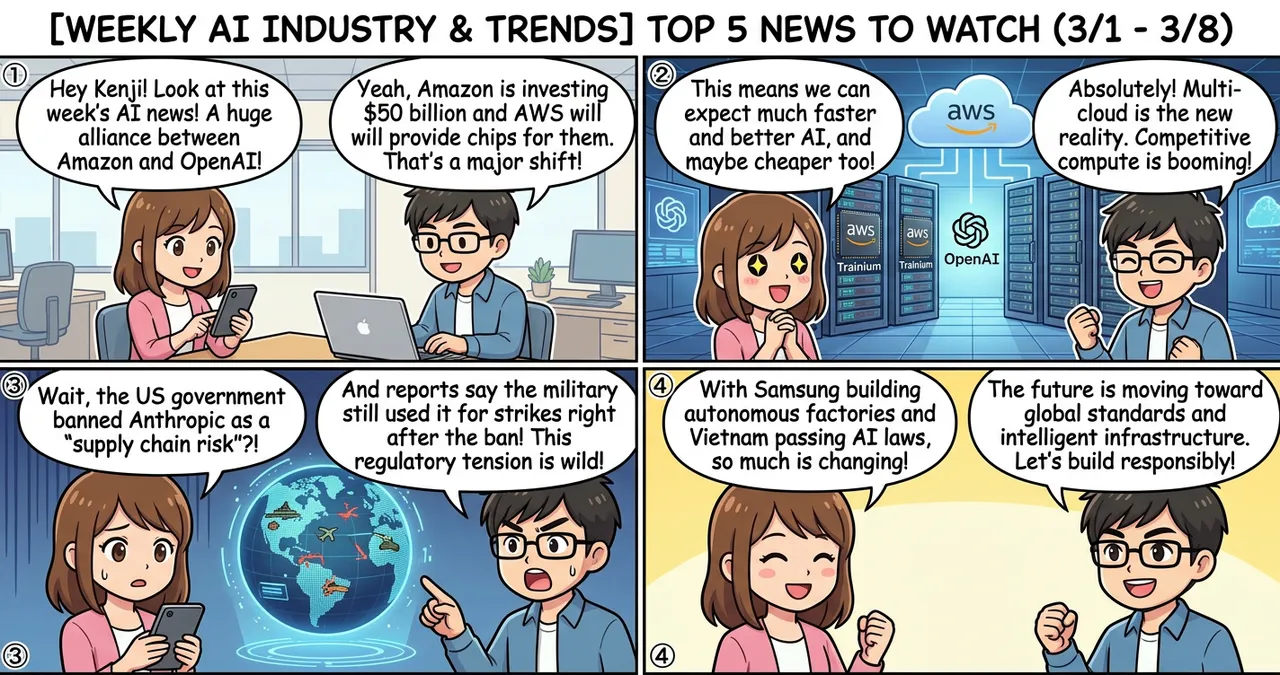
This Week’s Highlights
- Amazon and OpenAI forge a $50 billion strategic alliance shifting the cloud infrastructure landscape.
- The US government imposes a federal ban on Anthropic, sparking controversy over military usage.
- Regional and industrial shifts accelerate with Vietnam’s AI law and Samsung’s autonomous factory roadmap.
1. Amazon Announces Massive $50 Billion Investment in OpenAI
Key Point: Amazon invests $50 billion in OpenAI, making AWS a primary cloud and hardware provider.
This monumental deal signals a massive shift in the AI industry’s power dynamics. By investing $50 billion, Amazon secures a position as a key cloud provider for OpenAI alongside Microsoft Azure. A critical component of this partnership is the integration of Amazon’s custom Trainium AI chips, which aims to diversify OpenAI’s hardware reliance and optimize large-scale model training costs.
The collaboration suggests that the era of exclusive cloud partnerships may be evolving into a multi-cloud strategy for the most powerful AI labs. For the industry, this means increased competition in the high-end compute market and a significant boost for Amazon’s proprietary silicon efforts. You can read the full details in our post on [Amazon & OpenAI] Amazon Announces Massive $50 Billion Investment to Deepen Strategic Partnership with OpenAI.
🇯🇵 日本語解説 (必須/REQUIRED): AWSとOpenAIの提携強化はクラウド市場の勢力図を大きく変えるニュースです。特にAmazon独自チップ「Trainium」の採用は、NVIDIA一強のハードウェア市場におけるコスト削減と供給安定化に向けた重要な一歩となります。
2. US Administration Designates Anthropic as ‘Supply Chain Risk’
Key Point: The US government bans Anthropic products from federal use due to security concerns.
In a surprising regulatory move, the US administration has officially designated Anthropic as a “Supply Chain Risk.” This designation effectively prohibits federal agencies from using any Anthropic-developed AI products. The decision reportedly stems from ongoing disputes regarding the limitations placed on military applications of their models and concerns over the transparency of their underlying infrastructure.
This ban highlights the growing tension between AI safety-oriented startups and national security requirements. It sets a precedent for how the government might treat AI companies that resist specific defense-related mandates. For a deeper look at the policy implications, see [Anthropic Ban] US Administration Designates Anthropic as ‘Supply Chain Risk,’ Prohibits Federal Use.
🇯🇵 日本語解説 (必須/REQUIRED): Anthropicが「サプライチェーン・リスク」に指定されたことは、AI企業のガバナンスが国家安全保障と直結していることを示しています。開発者にとっては、公共案件における採用モデルの選定に大きな影響を与える可能性があります。
3. US Military Reportedly Uses Anthropic AI Despite Executive Ban
Key Point: Reports emerge of US military using Anthropic AI for strikes shortly after a ban.
Adding a layer of controversy to the regulatory news, a report from the Wall Street Journal revealed that the US military utilized Anthropic’s AI systems for airstrikes in the Middle East. What makes this particularly notable is that these actions allegedly occurred just hours after the executive ban on the company was initiated. This suggests a significant disconnect between high-level policy and theater-level operational dependencies.
The situation raises ethical and legal questions about the “off-switch” for AI systems integrated into defense workflows. It also underscores the high demand for advanced reasoning models in modern warfare. More details are available in [Anthropic Ban] US Military Reportedly Uses Anthropic AI for Airstrikes Hours After Executive Ban.
🇯🇵 日本語解説 (必須/REQUIRED): 禁止令の直後に軍事利用が報じられたことで、AI技術の現場への浸透度と規制の難しさが浮き彫りになりました。技術の軍事転用に関する倫理的議論が、今後さらに加速することは間違いありません。
4. Samsung Electronics Unveils 2030 AI-Driven Factory Strategy
Key Point: Samsung aims to transition global manufacturing to fully autonomous AI hubs by 2030.
Samsung Electronics has announced an ambitious roadmap to transform its global manufacturing footprint into fully autonomous, AI-driven factories. By 2030, the company plans to utilize edge computing, advanced robotics, and digital twin technology to minimize human intervention in the production process. This move is designed to enhance precision in semiconductor and electronics manufacturing while addressing global labor shortages.
This strategy represents a major leap for “Industry 4.0” concepts, moving from simple automation to intelligent self-optimization. The ripple effects will likely be felt across the global supply chain as other manufacturers race to keep up. Explore the roadmap in [Samsung AI Factory] Samsung Electronics Announces Strategy to Transition to AI-Driven Factories by 2030.
🇯🇵 日本語解説 (必須/REQUIRED): サムスンが掲げる2030年の完全自律型工場は、製造業におけるAI活用の究極の形と言えます。エッジAIやデジタルツインの活用は、日本の製造業にとっても非常に重要なベンチマークとなるでしょう。
5. Vietnam Implements Southeast Asia’s First Comprehensive AI Law
Key Point: Vietnam sets a regional precedent with new AI risk management and transparency laws.
Vietnam has become the first country in Southeast Asia to implement a comprehensive legal framework for AI. The new law focuses on risk-based management, mandatory labeling for deepfakes, and strict transparency requirements for AI agents interacting with the public. This move positions Vietnam as a regional leader in AI governance, aiming to balance innovation with public safety and ethical standards.
For developers and companies operating in the region, this law introduces new compliance hurdles but also provides a clearer roadmap for responsible development. As discussed in our previous coverage of [Vietnam] Southeast Asia’s First Comprehensive AI Law Takes Effect, this could serve as a model for neighboring nations.
🇯🇵 日本語解説 (必須/REQUIRED): ベトナムのAI法は、東南アジアにおける規制の先駆けとなります。ディープフェイクの表示義務や透明性の確保など、グローバルなトレンドに沿った内容であり、現地で展開するサービスには迅速な対応が求められます。
Weekly Summary
This week was defined by high-stakes moves in both the private sector and government chambers. Amazon’s massive investment in OpenAI reshapes the cloud landscape, while the US government’s actions against Anthropic highlight the friction between AI safety and national defense. As Samsung pushes the boundaries of industrial automation and Vietnam sets new regulatory standards, it is clear that AI is no longer just a software trend but a foundational element of global infrastructure and policy.
For a look back at the previous week’s trends, you can check our earlier summary: [Weekly AI Industry & Trends] Top 5 News to Watch (2/22 - 3/1).
![[Weekly AI Industry & Trends] Top 5 News to Watch (2/22 - 3/1)](https://4koma-news.com/images/posts/en/81-weekly-ai-news-other-2026-03-01-blog.webp)
![[Weekly AI Model Updates] Top 5 News to Watch (2/22 - 3/1)](https://4koma-news.com/images/posts/en/80-weekly-ai-news-model-2026-03-01-blog.webp)
![[Weekly AI Model Updates] Top 5 News to Watch (3/15 - 3/22)](https://4koma-news.com/images/posts/en/90-weekly-ai-news-model-2026-03-22-blog.webp)
![[Weekly AI Model Updates] Top 5 News to Watch (3/8 - 3/15)](https://4koma-news.com/images/posts/en/90-weekly-ai-news-model-2026-03-15-blog.webp)

