

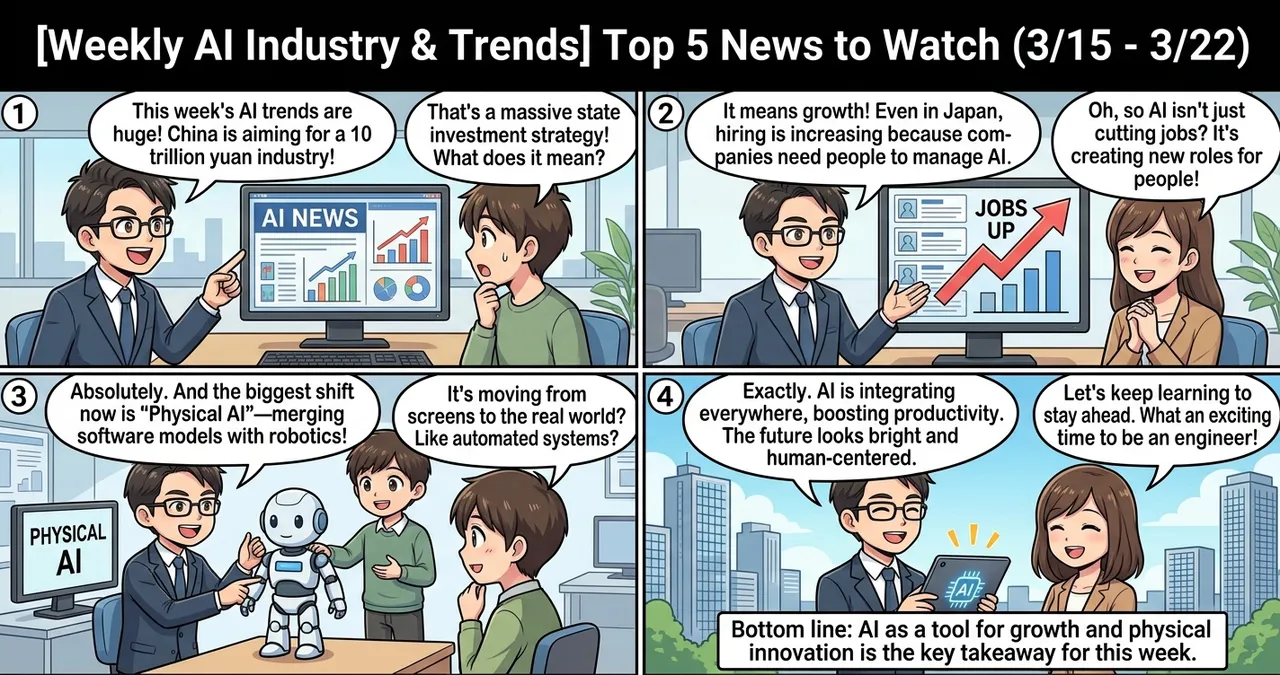
This Week’s Highlights
- China is aggressively scaling its AI industry to a 10 trillion yuan target by 2030 as a core national strategy.
- Japanese corporate hiring trends reveal that AI adoption is currently driving net growth in human talent rather than reduction.
- The emergence of “Physical AI” is shifting the industry focus from pure software models to integrated robotic and automated systems.
1. China’s 10 Trillion Yuan AI Expansion Goal
Key Point: China plans to grow its AI industry to over 10 trillion yuan by 2030 via the “AI Plus” national strategy.
The National Development and Reform Commission has officially integrated the “AI Plus” initiative into the upcoming 15th Five-Year Plan. This move signals a massive state-level commitment to not only software development but the deep integration of AI across all industrial sectors.
By setting such an ambitious financial target, China aims to secure global dominance in AI infrastructure and applications. For developers and global businesses, this marks a period of intensified resource allocation and rapid ecosystem expansion within the region.
📎 Source: JETRO
🇯🇵 日本語解説: 中国の国家的なAI産業育成は、今後数年で世界最大のAI市場が形成されることを意味します。エンジニアにとっては、中国発の技術スタックや大規模モデルの動向を注視し、国際的な開発競争の影響を考慮する必要があるでしょう。
2. Japanese Firms See AI Driving Job Growth Over Cuts
Key Point: A survey shows 36% of Japanese listed firms are increasing staff due to AI, outpacing those reducing headcount.
Contrary to fears of widespread displacement, recent data from Azusa Audit Corporation indicates that AI adoption is acting as a catalyst for hiring in Japan. With 36% of companies actively increasing personnel compared to 27% reducing, the demand for digital talent is clearly outpacing automation-led layoffs.
This trend underscores a critical shift: companies are prioritizing the integration of AI-literate employees to manage and scale their digital transformation (DX) efforts. The focus is moving toward upskilling and team expansion to remain competitive in an AI-driven economy.
📎 Source: KSB
🇯🇵 日本語解説: 日本企業においてAIは「人員削減の道具」ではなく「成長のための投資」と認識されています。デジタル人材への需要が非常に高まっており、エンジニアにはAIツールを使いこなし、業務プロセスを再構築できるスキルが求められています。
3. The Rise of “Physical AI” as a 2026 Trend
Key Point: “Physical AI,” which merges software with robotics and automation, is becoming a top market and industry priority.
The narrative of AI is moving beyond the screen. Investors and industrial engineers are increasingly focused on “Physical AI”—the application of foundation models to control robots and physical hardware. This intersection of AI and robotics is expected to redefine manufacturing, logistics, and service industries.
As hardware becomes more intelligent, the barrier between virtual intelligence and physical task execution is blurring. This trend suggests that the next wave of innovation will be defined by how effectively models can interact with the real world.
📎 Source: Kabutan
🇯🇵 日本語解説: ソフトウェア単体から、ロボット等のハードウェアと連携するAIへの転換が加速しています。制御エンジニアやロボティクス領域との融合が重要になっており、物理世界で稼働するAIシステムの開発経験が今後大きな価値を持つでしょう。
4. Microsoft 365 Copilot Chat Usage Restrictions
Key Point: Microsoft introduced new usage restrictions for Copilot, though potential revisions are being considered due to user feedback.
Microsoft has implemented changes that limit access to Copilot for users without specific add-on licenses. This move aims to clarify the enterprise licensing structure, but the immediate backlash from users suggests that the company may need to refine its accessibility strategy.
For businesses relying on Copilot for daily workflows, this serves as a reminder to closely monitor licensing compliance and service policies. As AI tools become deeply embedded in office productivity, consistent access management is becoming a significant operational challenge.
📎 Source: ITmedia
🇯🇵 日本語解説: 企業向けAIツールのライセンス体系は今後も流動的です。開発環境や業務ツールを選定する際は、コストだけでなく、ベンダー側の仕様変更リスクを考慮した運用体制を構築しておくことが不可欠です。
5. Qingdao Launches AI-Powered “One-Person Company” Support
Key Point: Qingdao is building specialized parks to support individual entrepreneurs using AI tools for small-scale business.
The city of Qingdao is establishing a dedicated ecosystem to foster “One-Person Companies” (OPCs) that leverage AI for operational efficiency. By providing access to computing resources and proprietary models, the city hopes to lower the barrier to entry for solo-entrepreneurs and tech-savvy startups.
This initiative highlights a growing trend of “AI-enabled solo-preneurship,” where a single individual can accomplish the work of a small team using AI-driven automation. If successful, this model could be a blueprint for other cities aiming to boost innovation from the ground up.
📎 Source: JETRO
🇯🇵 日本語解説: AIを活用して個人が小規模企業を運営する動きが中国で公的に支援され始めています。これは、AIツールが単なる効率化ツールを超え、個人の起業や価値創造の基盤となっていることを示す興味深い事例です。
Weekly Summary
This week showcased a clear transition toward the practical, large-scale application of AI, ranging from China’s state-level industrial targets to the emergence of “Physical AI” in the robotics sector. Meanwhile, the Japanese market reflects a growing demand for human talent in the AI era, signaling that the industry is prioritizing growth over automation-led reduction. As these trends evolve, staying updated on both licensing changes and new physical-world capabilities will be essential for developers. 🚀
![[Weekly AI Model Updates] Top 5 News to Watch (3/15 - 3/22)](https://4koma-news.com/images/posts/en/90-weekly-ai-news-model-2026-03-22-blog.webp)
![[Weekly AI Industry & Trends] Top 5 News to Watch (3/8 - 3/15)](https://4koma-news.com/images/posts/en/91-weekly-ai-news-other-2026-03-15-blog.webp)
![[Weekly AI Model Updates] Top 5 News to Watch (3/8 - 3/15)](https://4koma-news.com/images/posts/en/90-weekly-ai-news-model-2026-03-15-blog.webp)
![[Weekly AI Industry & Trends] Top 5 News to Watch (3/1 - 3/8)](https://4koma-news.com/images/posts/en/89-weekly-ai-news-other-2026-03-08-blog.webp)

